Backdoor Roth IRA 2025: How It Works, Why to Use it, and Tax Considerations

Backdoor Roth IRA

The Backdoor Roth IRA is a strategy that enables high-income earners to make Roth IRA contributions indirectly when their income exceeds the limits.  Why do they care?  High earners benefit from high cash savings and a Roth IRA allows a greater contribution towards retirement.  Funds in a Roth IRA grow tax-deferred and may be eligible for tax-free distributions in retirement.  A Roth IRA can be an effective tax strategy for managing tax brackets in retirement and a legacy planning tool.  So how can you benefit from this strategy anyways?  Insert -> the Backdoor Roth IRA strategy.

What is the Backdoor Roth IRA?

The Backdoor Roth IRA is a tax strategy that helps high-income earners contribute to a Roth IRA when they’re over the income limits (in 2025, $165,000 for single filers and $246,000 for married couples) by contributing to a traditional IRA and then converting it to a Roth IRA.

First, you make an IRA contribution (up to $7,000 in 2025 for those under 50 years old and $8,000 for those over 50 years old) by April 15th 2026.  Then, you can convert this IRA contribution to a Roth IRA.  Over time, the Roth IRA compounds and becomes a valuable addition to your retirement savings. 

Who Should Consider a Backdoor Roth IRA?

If you are:

  • Above the income threshold for a Roth IRA contribution
  • Have extra cash during the year and want to save towards retirement
  • Are willing to take the steps to set yourself up for a successful Backdoor Roth strategy

When a Backdoor Roth Makes Sense

At SeedSafe Financial, we work with tech professionals who want to get out of the game by their 50s.  The Backdoor Roth strategy can be a great way to increase retirement savings.

Many of our tech clients have excess cash from IPOs or large amounts of RSUs – their taxable investments often dwarf retirement savings.  This strategy reduces the taxable impact of investing while they are in higher tax brackets.

We also use this for clients who want to leave money to their children when they pass.  At this time, a Roth IRA can be passed down to your children with minimal tax impact.  For more advanced estate planning, a Roth IRA with a Trust beneficiary can be helpful.  Trusts that hold IRAs and Roth IRAs must take distributions on a reduced timeline than if left to children.  The Roth IRA reduces the tax impact of the required distributions while still maintaining control over when the kids get the money.

Step by Step:  How to Do a Backdoor Roth IRA

*Warning: keep reading below before you follow these instructions for the mistakes to avoid*

The Backdoor Roth IRA strategy is not for the faint of heart – it takes time and diligence to make sure you enact it correctly:

  1. Open a Traditional IRA at your custodian of choice
  2. Make a ‘non-deductible’ IRA contribution for the year
  3. Invest it and wait a bit to convert it
  4. Open a Roth IRA account at the same custodian
  5. Call the custodian and ask to convert the Traditional IRA to the Roth IRA account
  6. Report the conversion on IRS Form 8606
  7. Repeat annually
  8. Keep track of your basis in each the Traditional IRA and Roth IRA in case of future legislative changes

And there you have it! You’ve completed the steps for a Backdoor Roth IRA! 

Understanding the Tax Implications

Here comes the tricky part – because there is always a catch when the IRS allows you to do something like this.  The Pro-Rata rule.

What is the Pro-Rate Rule?

The Pro-Rata rule in Roth IRA conversions is an additional wrinkle to consider.  If you have pre-tax IRA money and non-deductible contributions in one account, the conversion will be partially taxable.   An example of pre-tax IRA money is if you rolled a past 401(k) into your IRA.

Why does this happen?  You are making a ‘non-deductible’ IRA contribution.  A non-deductible IRA contribution means you are over the income limits to be able to deduct this amount on your tax return.  So you are making a contribution ‘post-tax’.  When you make a ‘post-tax’ contribution, it has a cost basis similar to when you purchase taxable investments.   This cost basis in the IRA is not taxable in a conversion.  However, anything pre-tax is.

Let’s look at an example:  Dave rolled his 401(k) from a past employer to a Traditional IRA in the amount of $500,000.  A few years later, Dave decides to start making an annual non-deductible IRA contribution.  He forgets to convert it for a few years and now his Traditional IRA is at $600,000 in total with $21,000 in basis from non-deductible IRA contributions.   If he decides to convert the $21,000 now, the IRS will tax part of it as income.

($600.000 – $21,000) / $600,000 = 96.5%

96.5% of the $21,000 = $20,265 taxable income in the year of conversion

That was not what we wanted to happen from a tax efficiency standpoint.

So how do you fix this issue?  If you are still employed, we often suggest rolling the pre-tax amount back into your 401(k).   Then, with just the $21,000 in your Traditional IRA, the result will be very little taxation at conversion.

Disclaimer: This example is hypothetical and provided for illustrative purposes only.

Common Mistakes to Avoid

Based on the above conversation, there are certainly a few mistakes you can easily make:

  • Having a mix of pre-tax and non-deductible funds in your Traditional IRA account
  • Forgetting to file the Form 8606 when you make the conversion (to track your non-deductible contributions and basis)
  • Doing the conversions too quickly and running into the IRS substance test.  Aka, if it looks like a Roth IRA contribution and smells like a Roth IRA contribution, it is.
  • Not tracking your Traditional IRA basis on an ongoing basis with your tax return 

Backdoor Roth IRA vs. Mega Backdoor Roth

Is there an easier or better way to do this?  Many of our big tech clients at Google, Amazon, Apple, Meta, Microsoft and their portfolio companies have the option of an ‘After-Tax 401(k)’.  This is included in their 401(k) company benefits and will show up in the contributions area for the plan.

The After-Tax 401(k) allows you to make a Mega Backdoor Roth Contribution!  We detail out this strategy and the benefits on our blog post Is a Mega Backdoor Roth Strategy Worth It?  The Mega Backdoor Roth is a Backdoor Roth on steroids – a higher contribution amount and less complication with the pro-rata rules.  

Summary FAQs About the Backdoor Roth IRA

  1. Is the Backdoor Roth IRA still legal in 2025?

Yes. The Backdoor Roth IRA remains legal and IRS-approved in 2025. No current legislation has eliminated this strategy for high-income earners.

  1. Who should use a Backdoor Roth IRA?

It’s best for high-income earners who exceed Roth IRA income limits ($165,000 single / $246,000 joint in 2025) but want tax-free retirement growth.

  1. What is the Pro-Rata Rule?

If you hold both pre-tax and after-tax IRA funds, the IRS taxes conversions proportionally. Rolling pre-tax funds into a 401(k) can help avoid extra taxes.

  1. What’s the difference between a Backdoor Roth and a Mega Backdoor Roth?

A Backdoor Roth uses an IRA; a Mega Backdoor Roth uses after-tax 401(k) contributions to convert much larger amounts – up to roughly $70,000 per year.  This limit includes your employee contribution (up to $23,500 in 2025) + employer match + after-tax 401(k) = $70,000 max.

  1. Can I do a Backdoor Roth every year?

Yes. As long as conversions are allowed, you can complete a Backdoor Roth annually and track it with Form 8606.

At SeedSafe Financial, we believe wealth isn’t just about saving – it’s about strategy. The Backdoor Roth IRA can be one of the simplest ways to grow tax-free wealth and build a lasting legacy. Ready to see how it fits into your plan? Let’s make your money move with purpose.

Thinking about other year end strategies or going through benefits enrollment?  Check out our other blog posts:

Disclaimer:
This guide is provided for informational and educational purposes only and does not constitute legal, tax, or investment advice. The strategies discussed, including the Backdoor Roth IRA, may not be appropriate for all individuals or situations. Eligibility and outcomes depend on many factors, including your personal financial situation and current federal and state tax laws, which are subject to change.

Any examples provided are hypothetical and for illustrative purposes only. They do not represent actual client outcomes, and actual results will vary. You should consult with qualified tax, legal, and financial professionals before taking any action related to Backdoor Roth IRAs or any other tax planning strategies.

When Can You Sell Company Stock? Rule 10b5-1 Plans for Tech Professionals

10b5-1 plan

Just Promoted? Here’s Why You May Face New Limits on Selling Your Stock

If you’ve stepped into a Director or C-suite role at your tech company, you might suddenly face new restrictions on when and how you can sell your equity. These rules aren’t just bureaucratic red tape – they exist to prevent insider trading and uphold market integrity.  A 10b5-1 plan may help you in this case.

Understanding trading restrictions and how a Rule 10b5‑1 plan works can help you.  Understanding these restrictions can help you discuss options with your legal, tax, and financial advisors to stay compliant and create a thoughtful strategy for managing your equity.

Let’s unpack it together!

What are trading restrictions for tech companies?

Trading restrictions occur to prevent insider trading in public companies.  When a tech startup IPOs, there may be a few types of trading restrictions at the start:

  • Lock-up Period:  This generally occurs during the first 6 months of the IPO trading on the stock market.  This is meant to prevent employees from selling / ‘dumping’ their shares on the stock market and destabilizing the price.  Many banks who help tech startups IPO will make this a stipulation since they assist with supporting a pricing window during this time.
  • Blackout Period:  This restriction applies to employees with access to material, nonpublic information.  Generally, this covers the C-Suite, Directors in charge of major P&L items, and many finance team members.  The blackout period generally exists some time frame between quarterly earnings calls.   This way, the thought is that the quarterly earnings call will allow the public to have the same information as a potential insider.  Some key employees may be further restricted.

Technically, the SEC requires employees with >10% ownership in the company to follow these restrictions.  However, it is up to the tech company to decide who is a key employee beyond these individuals.  You may learn your promotion comes with a few more restrictions!

What is a Rule 10b5-1 Plan and How Does It Work?

A Rule 10b5-1 plan is a concept the SEC came up with to help employees comply with the trading restrictions they impose.  The theory is that if an ‘insider’ or key employee states their intentions around stock sales in advance, then the risk of insider trading goes down.  This can, can prevent the accusations of insider trading and level the playing field.

The plan will state the types of stock subject to the plan – options, RSUs, or ESPP shares.   Then it will ask for other details:

  • Grant ID
  • Date Shares Acquired/Vested
  • Sale Period 
  • Authorized Number of Owned Shares for Sale
  • Limit Price or Market Price

Then, these details go to the Custodian and Company to approve.

Note:  If you do not follow your plan, the protections of the Rule 10b5-1 Plan may no longer apply for ‘insider’ trading.

What Are the Benefits and Risks of a 10b5-1 Plan?

Pros and cons of a 10b5-1 plan may be up for interpretation by each individual 🙂  So let’s talk more about the features of a 10b5-1 plan:

  • When properly established and followed, a Rule 10b5-1 plan may offer an affirmative defense against insider trading allegations. However, this depends on individual circumstances and adherence to plan requirements
  • It can allow you to trade throughout the year, instead of waiting for black out periods to end 
  • You are able to potentially diversify out of your company stock in a more consistent manner
  • It can take the emotions out of the decision to sell.  You won’t need to remember how much to sell or worry about the stock price changing during the window you can sell
  • You will be subject to a cooling off period before, or during termination, of your 10b5–1 plan
  • If you change your mind and wish to modify or terminate your 10b5-1 plan, you may be subject to more scrutiny and potential allegations

What Is the Cooling-Off Period for a Rule 10b5-1 Plan?

The cooling off period is usually between 30 to 90 days before the 10b5-1 plan takes effect.  The cooling off period does not allow you to sell any shares during this time.  

The cooling off period also applies if you decide to modify or terminate your 10b5-1 plan.  It is important to work with your company to understand your company’s insider-trading policy.

What Should I Ask My Company Before Starting a 10b5-1 Plan?

Key questions you should ask before implementing a 10b5-1 plan include:

  • Who is allowed to put a 10b5-1 plan in place?
  • How long does the 10b5-1 plan need to apply?  1 year?  
  • What kind of sales are prohibited as part of the plan?
  • Am I allowed to modify or terminate the plan during open trading windows?
  • If I do modify or terminate the plan, what is the waiting/cooling off period before I can trade shares again?
  • Will my Rule 10b5-1 plan be publicly disclosed?
  • Once I establish my 10b5-1 plan, can I trade additional shares outside of the plan?

Summary: How a Rule 10b5-1 Plan Helps Insiders Sell Stock Legally

  • Trading restrictions apply to insiders after IPOs and around earnings
  • A Rule 10b5-1 plan lets you pre-schedule trades legally
  • Plans must include key details like timing, share amounts, and prices
  • You must follow a cooling-off period before trades can begin
  • Modifications require caution – breaking the plan may void protection

Other Related Blog Posts

Disclaimer:

This content is for informational purposes only and does not constitute legal, tax, or investment advice. You should consult with your own legal, tax, and financial advisors before taking any action related to equity compensation, insider trading policies, or Rule 10b5-1 plans. SeedSafe Financial LLC is a registered investment advisor and does not provide legal or tax advice. Regulatory and company-specific rules may vary and are subject to change.

A Guide to QSBS: How Your Startup Exit May Qualify for Federal Tax Savings

QSBS Qualified Small Business Stock Exclusion Startup

Did You Know Part of Your Startup Exit Could Be Tax-Free?

If you’re a founder, early employee, or investor in a high-growth startup, a little-known tax benefit could help you exclude up to $10 million (or more with the OBBBA changes) of capital gains from federal taxes. It’s called the Qualified Small Business Stock (QSBS) exclusion, and for those who qualify, it can mean massive tax savings upon exit.

Let’s break it down – clearly, calmly, and in plain English.

What Is QSBS? (Qualified Small Business Stock)

QSBS is a provision in Section 1202 of the tax code that allows shareholders of certain small businesses to exclude capital gains from federal tax when they sell their stock – if they meet five specific requirements.

Under current rules, you may be able to exclude 100% of your gain, up to $10 million or 10x your original investment (whichever is greater).

Who Qualifies for the QSBS Exemption?

To be eligible for QSBS treatment, you must meet five criteria:

  1. The stock must have been directly acquired via an original issuance from a U.S. C corporation (Sec. 1202(c)(1));
  2. Both before and immediately after stock issuance, the C corporation’s tax basis in gross assets did not exceed $50 million (Sec. 1202(d)(1));
  3. The C corporation and shareholders must consent to supply documentation regarding QSBS (Sec. 1202(d)(1)(C));
  4. The C corporation conducts certain qualified active trades or businesses (Sec. 1202(e)); and
  5. The stock must have been held for 5 or more years (Sec. 1202(b)(2)).

You can find a great cheat sheet put together by Cooley HERE. Please note this is a third-party resource and SeedSafe Financial LLC is not affiliated with Cooley or responsible for the content on their site.

What Changed with the New Law?

The Opportunity to Build Back Better Act (OBBBA) made key changes to QSBS for stock acquired on or after July 5, 2025:

  • Tiered Holding Period:
    • 3 years = 50% gain exclusion
    • 4 years = 75% exclusion
    • 5 years = 100% exclusion
  • Cap Increase: The $10M limit rises to $15M, adjusted for inflation starting in 2027
  • Gross Asset Test Increase: From $50M to $75M, also inflation-adjusted

**Important: If you acquired your stock before July 5, 2025, the original rules still apply.

Understanding your specific exemption requirements is important.

QSBS and Industry Eligibility

Many types of early-stage tech startups qualify under the industry requirement. However, if you’re in FinTech, healthcare, or another excluded industry, the analysis is more nuanced. It’s crucial to confirm with your company and tax advisor whether your stock qualifies.

Federal QSBS Exclusion: By Acquisition Date

Acquisition Period

Percent Exclusion (Regular Tax)

AMT Add-Back

Before Feb 18, 2009

50%

7%

Feb 18, 2009 – Sept 27, 2010

75%

7%

Sept 28, 2010 and later

100%

0%

Note: QSBS gains are taxed at a special 28% rate if not fully excluded. Higher earners should also factor in the 3.8% Net Investment Income Tax (NIIT).

Most sales for higher wage earners will trigger AMT. For AMT purposes, 7% of the excluded gain is added back to taxable income for the computation of stock sold before Sept 28, 2010.

Hopefully, at this point, any stock from pre-2010 has either exited or the company has dissolved so you can take a capital loss on the investment.

QSBS Example: How It Might Work in Practice

Scenario:

  • You and your spouse earn ~$500,000/year
  • You sell startup stock acquired in Jan 2019
  • Gain = $2.5M on $500K basis
  • You live in California

If QSBS Applies:

  • $2.5M gain excluded from federal tax
  • California tax due: ~$307,500
  • Effective tax rate: ~12.3%

If QSBS Does Not Apply:

  • Federal tax due: ~$595,000
  • California tax due: ~$307,500
  • Effective tax rate: ~36.1%

The difference? Nearly $600,000 in tax savings.

Disclaimer: This example is hypothetical and provided for illustrative purposes only. Your circumstances and results will vary.

What Documentation Do You Need to Claim QSBS?

To successfully claim QSBS treatment and avoid trouble during an audit, gather:

  • Stock purchase proof (certificates, checks, 83(b) election)
  • Company confirmation of C Corp status (e.g., IRS Form W-9)
  • Valuation docs at time of acquisition (especially for founders or early employees)

We strongly recommend working with a qualified tax advisor for the year of the sale.

Most states don’t follow the federal QSBS exclusion, so you may still owe state capital gains tax. California, for instance, does not conform – so plan accordingly.

Summary: QSBS Key Takeaways

  • You may qualify to exclude up to $10M or more in startup gains from federal taxes
  • You must meet five IRS criteria—original issuance, asset limit, active business, 5‑year holding, and documentation
  • New rules phase in for stock acquired July 5, 2025 or later
  • Most states do not follow federal QSBS rules—keep a reserve
  • Documentation is critical. Work with a professional to confirm eligibility and file correctly

Hire a tax preparer for the year in question. The simplified example above does not include a discussion of how each state may further tax your business gain. They will also make sure they have the documentation to support the QSBS exclusion on file in case of audit.

At SeedSafe financial, we believe financial clarity isn’t just about minimizing taxes – it’s about creating space to live well, align your wealth with what matters, and move forward with confidence.

If you’re navigating an exit—or want help understanding whether your shares may qualify for QSBS—we’re here to help you explore your options. We collaborate with your tax and legal professionals to support you with precision and care. 

Other Blog Posts to Check Out

Disclaimer:

This guide is provided for informational and educational purposes only and does not constitute legal, tax, or investment advice. The strategies discussed, including the Qualified Small Business Stock (QSBS) exclusion, may not be appropriate for all individuals or situations. Eligibility depends on many factors, including your personal circumstances, company structure, and current federal and state tax laws, which are subject to change.

Any examples provided are hypothetical and for illustrative purposes only. They do not represent actual client outcomes, and actual results will vary. You should consult with qualified tax, legal, and financial professionals before making decisions related to QSBS or any other tax planning strategies.

References to third-party resources or websites are provided for informational purposes only. SeedSafe Financial LLC does not endorse or assume responsibility for the accuracy or completeness of external content.

Advisory services are offered through SeedSafe Financial LLC, a Registered Investment Advisor. Registration does not imply a certain level of skill or training. Federal tax exclusions such as QSBS may not apply to state-level taxes. State rules vary, and some states do not conform to federal QSBS provisions.

Navigating IPOs and Incentive Stock Options (ISOs)

ISOs in IPO

If your company is preparing for an Initial Public Offering (IPO), it’s an exciting time—especially if you hold Incentive Stock Options (ISOs). But before you rush to exercise those options, there are crucial considerations that could make or break your financial strategy.

What are Incentive Stock Options (ISOs)?

Incentive Stock Options are a type of employee stock option that comes with potential tax benefits, making them an attractive component of your compensation. They allow you to buy company stock at a set “exercise price,” typically the market value at the time of the grant. The options become exercisable according to a vesting schedule, which usually spans four years, and they come with an expiration date by which you must take action.

If you don’t exercise your ISOs by the expiration date, they expire and are worthless. Generally, you have up to 10 years if you’re still employed, but if you’ve left the company, this window can shrink to as little as 90 days or sooner if your company is nearing an IPO. 

Dig out that options agreement to confirm how your ISOs are treated with an IPO!  Some sample language can be found in the Reddit stock agreement.

ISOs, if managed properly, may only be taxed at the more favorable long-term capital gains rate. However, you must hold your shares for at least one year after exercising and two years after the grant date. Meeting these requirements means the sale of your ISOs will qualify for long-term capital gains tax, which could result in a significant tax savings compared to ordinary income tax rates.

What are Non-Qualified Stock Options (NQSOs)?

Before diving into the IPO conversation, let’s quickly break down how ISOs differ from Non-Qualified Stock Options (NQSOs).

NQSOs are generally given early on in a startup’s trajectory, to advisors, or as additional incentives as employees reach the ISO limit.

With NQSOs, you’ll pay taxes at the time of exercise, recognizing ordinary income on the difference between the stock’s value and your exercise price. This is a big difference from ISOs, which may be eligible for long term capital gains treatment at their sale.

However, ISOs come with limitations. You can only vest up to $100,000 in value of ISOs in a given calendar year to enjoy this tax benefit. Anything over this amount is treated as NQSOs.

Check your stock portal to see if this ‘ISO/NQSO split’ is occurring over your vesting period.  Often, this will happen more in the later years of vesting as the stock value quickly rises.

— Do you learn better from audio or video?  Check out this conversation on our YouTube video about this topic HERE

Be Aware of the AMT Trap

Even though ISOs offer appealing tax treatment, they come with a catch: the Alternative Minimum Tax (AMT). AMT is a parallel tax system that kicks in when certain “preference items,” like ISOs, push your tax liability higher.

The AMT system has only two tax rates, 26% and 28%, and a larger exemption rate (as of 2024).  You only see AMT on your tax return if your AMT tax due is larger than your regular tax due.   

When you exercise your ISOs, the difference between the stock’s current value and your exercise price (known as the bargain element) is included in your AMT calculation. If you’re exercising a small number of options, you might not notice the impact. However, if you exercise a large number of options, the AMT can take a big bite out of your finances.

For example, we’ve seen AMT taxes due soar to $250,000 or more on ISO larger exercises. So, before you exercise, make sure you have a tax professional in your corner to help you navigate the complexities.

The IPO Opportunity: Timing Your ISO Exercise

So, why exercise ISOs ahead of an IPO?

An IPO creates a liquid market for your company’s stock. By exercising your ISOs pre-IPO, you could lock in a lower stock price and start the clock on your long-term capital gains tax treatment. 

However, the stock price could fluctuate dramatically after the IPO, making this a risky move if you expect an IPO soon. NASDAQ research from April 2021 showed that while 34% of IPOs gained over 10% in their first year, more than 50% lost 10% or more.

If your company is eyeing an IPO within the next 18-24 months, now might be a good time to assess how much cash you can afford to put at risk. Exercising a portion of your ISOs each year could help you spread out the AMT cost and mitigate some risk if the IPO is delayed.  We like to call this ‘laddering’ our exercises (and potential sales) to minimize taxes across the board.

Not sure if an IPO is in your future?  Check out our blog post on when to consider exercising stock options as a pre-IPO company here.

Case Study: Jane’s ISO Strategy

Let’s consider a real-world example. Jane, a long-term employee at a tech startup, is weighing her options ahead of the company’s IPO.

Jane received two ISO grants:

  1. 10,000 shares at $0.10 per share, which she exercised early with an 83(b) election.
  2. 10,000 shares at $3.00 per share, which she hasn’t yet exercised due to the cost to acquire them ($30,000).

With her company’s IPO on the horizon, Jane and her advisor reviewed her financial situation to determine how much cash she could comfortably invest in exercising her ISOs. 

After accounting for her emergency savings and other expenses, she decided to allocate $10,000 toward her stock options.

Together, they calculated the potential AMT liability based on the current 409A valuation and the expected IPO price. By exercising some ISOs before the IPO this year and planning to sell RSUs after the IPO, they managed the risk while maximizing the tax benefits.

The Takeaway: Make an Informed Decision

Exercising ISOs ahead of an IPO can be a smart move, but it requires careful planning. Be sure to evaluate your financial situation, risk tolerance, and tax implications before making any decisions. Working with a financial advisor and tax professional can help ensure you navigate this complex process successfully.

If you’re considering exercising your ISOs before an IPO, weigh the risks, rewards, and your financial goals carefully. With the right strategy, you can maximize your wealth while minimizing unnecessary taxes.

Looking for a Financial Partner in your IPO journey?  Schedule a call with us to learn more.

The above discussion is for informational purposes only.  Recommendations are of a general nature, not based on knowledge of any individual’s specific needs or circumstances, and there is no intent to provide individual investment advisory, supervisory or management services.

What is the maximum 529 contribution? Should I fully fund it?

What is the maximum 529 contribution? Should I fully fund it?

What is the maximum 529 contribution?  This question can actually mean two separate things.

  • What is the annual maximum contribution I can make before gift taxes apply?
  • What is the maximum contribution I can make in total to my 529 plan?
  • What should I fund for a 529 plan for my child(ren)?
Let’s break these questions down…
 

Annual Maximum 529 Contribution

When you hear ‘maximum 529 plan contribution’, this usually refers to the annual gift tax exclusion.  A 529 contribution is considered a gift to another person (i.e. your child).  Gifts to other individuals above a certain threshold are taxable events in the United States.
 
For the 2024 tax year, gift taxes may apply for gifts above $18,000 per individual (or $36,000 for married couples filing jointly).  
 
This applies to 529 contributions as well.  You can contribute up to $18,000 each year, per child, without having to pay gift tax as of 2024.  This amount can change annually based on inflation.
 
On the flip side, 529 contributions may earn you a tax deduction or tax credit in certain states.  Generally, to obtain the tax deduction or credit, you must use the 529 plan designated by the state.  The benefit can range from $80 to $1,200+ in a reduction of state taxes.  Find out whether your state offers a benefit HERE.
 
If you are willing to file a Gift Tax Return (Form 709), you can stretch this contribution even further in a year.  
 

The 5-Year Election for 529 Contributions

If you are going through an IPO or a large liquidation event in one year, you may decide to make a ‘5 year election’ to superfund your 529 plan.  
 
This means you can contribute up to $90,000 per individual (or $180,000 for married couples filing jointly) to a 529 plan in a year.  The catch is you cannot make further contributions to the 529 plan in the following 4 years and you must file a Gift Tax Return.
 
The benefit of making the 5 year election is mostly around time.   You fund the 529 plan now and allow more time for the investments to grow.  This can be a great way to ‘set it and forget it’.
 

Total Maximum Contribution to a 529 Plan

So if I can technically make a 529 plan contribution each year up to $36,000 for married filing jointly couples and I start the day my child is born, I could actually put in $648,000 by the time they graduate from high school???
 
Nope!
 
529 plan total contribution limits range from $269,000 to $570,000, depending on the state.   This limit really boils down to what the state believes is a good estimate for attending school.  North Dakota believes this to be $269,000 while Utah says this is $560,000.  
 
Where you open your 529 plan should account for tax benefits, plan costs, investment choices, and how much you plan to contribute to it.
 

Funding a 529 plan for your child

Whether or not you should fund your 529 account to the max depends on a number of factors, including your income, your savings goals, and your child’s age. Here are some things to consider:
  • Your income: If you are in a low tax bracket and expect to stay there, you may be eligible for financial aid through the FAFSA process.  Get to know the components of how your ‘expected family contribution’ (EFC) is calculated to know how much would be expected of you in today’s dollars.  If you are in a higher tax bracket or you’ve accumulated $2 million+ in investments, you will need to pay for the majority of your child’s college expenses.
  • Your savings goals: Prioritize retirement savings and high-interest rate debt first. Put your own oxygen mask on first before helping a child!  Then, if you feel comfortable you are on track financially, then consider what 529 contributions you can make. 
  • Your child’s age: If your child is young, you have more time to allow the 529 contribution to grow. This may mean a few years of maximum annual contributions will go a long way.  However, if your child is older, you may need to contribute each year in order to save enough money.  If your child is already in high school, you may want to consider whether a 529 plan is still the best option for you.
  • Your child’s college plans: If your child is likely to attend a state school, you may not need to save as much as if they are planning to attend a private school. This is because state schools are typically less expensive than private schools.

The 529 conundrum

The best time to fund a 529 plan is when your child is still under age 3 for the largest potential growth… but you should only fund it based on what kind of college you expect them to attend…  What does that mean I should do? 
Ultimately, the decision of how much to contribute to your 529 account is a personal one. There is no right or wrong answer. 
 
At SeedSafe Financial, we make sure our clients are on track financially.  Then, we balance retirement dreams, expense expectations, and the desire to set their family up for success.   This means each family may have a different plan:
  • some may contribute $36,000 for a few years and stop,
  • others may contribute $8,000 a year until high school, 
  • and a few will make a 5 year election and superfund a 529 plan to the max
The important piece of this is to know what you can afford to do that doesn’t put your own long term safety at risk.
 

Why should I consider contributing the total maximum to a 529 plan?

If you are in a good place financially, making $1M+ a year, or have a net worth of $10M+, there is a case to consider contributing the total maximum allowed.
 
It’s called the ‘multigenerational’ 529 plan strategy (or Dynasty 529 plan).
 
This is where you use a single 529 plan account to support education for multiple individuals.  You start by creating the plan for your child and contribute up to the maximum $560,000 over the first 15 years.  
 
Then, you utilize the funds for college expenses for your child (as intended).  However, there will most likely be quite a bit left as the investments continue to grow.  What happens to this ‘leftover’ money?
 
The IRS allows for a beneficiary of a 529 plan to be changed to “a member of the family” of the beneficiary.  This means you could change the beneficiary from your child to your grandchild in the future.
 
The goal is for the investments to continue to grow over long periods of time – allowing the gains to compound.  Then,  when each future generation goes to college, they are able to use those gains and continue the line of funding.  This feels like magic.
 
And with all magic, the IRS wants to know it isn’t being abused.  Changing the beneficiary may still trigger the gift tax rules (remember those from the beginning of the article?).  However, another 5-year election or part of the lifetime gift exclusion could be used to help offset this tax cost.  (Work with your tax advisor to make sure this is correctly reported).
 

That is a lot to think about.

Remember how I said there is no right or wrong answer?  Consider your individual circumstances and make the decision that is best for you and your family.
 
Some tips we suggest for all 529 plans:
  • Start early: The sooner you start saving, the more time your money has to grow in the account. Even if you can only contribute a small amount each month, it will add up over time.
  • Set up a regular contribution schedule: One of the best ways to save for college is to set up a regular contribution schedule. This will help you stay on track and reach your savings goal.  You may decide to use ESPP funds on a quarterly basis, RSUs as they vest, or from your paycheck.  Whatever method you choose, make it consistent.
  • Take advantage of gifts:   Let family know you’ve set up the 529 plan and send them a gift link.   You may be pleasantly surprised at who all wants to help fund your child’s education 🙂
  • Get professional advice: If you are not sure how much to contribute or which type of 529 plan is right for you, be sure to get professional advice from a financial advisor.  
If you don’t have a financial advisor, consider scheduling some time to chat with us.
 
Did you enjoy this article and are looking for other ways to set your child up for financial success?  Check out our blog post HERE.
 
The above discussion is for informational purposes only.  Recommendations are of a general nature, not based on knowledge of any individual’s specific needs or circumstances, and there is no intent to provide individual investment advisory, supervisory or management services.


Is a Mega Backdoor Roth Strategy Worth it?

Is a Mega Backdoor Roth Strategy Worth it?

If you’ve joined the tech industry in the last 5 years, you’ve seen a huge adoption of the ‘after-tax 401(k)’.  The after-tax 401(k) is an employee benefit that allows you to put more money away for retirement and implement the Mega Backdoor Roth strategy.  We see this often available for our clients at larger tech companies like Amazon, Google, and Microsoft.  

There are many articles on what a Mega Backdoor Roth is, but fewer that explain why you should do it and how to do it.

If you’re considering whether this strategy is worth it for you, below is a detailed look at what it is, the benefits, and potential pitfalls.

What is a Mega Backdoor Roth IRA?

First, a quick breakdown of how the Mega Backdoor Roth strategy works. Essentially, it’s a way to convert after-tax 401(k) contributions into a Roth IRA. Here’s how it works:

  1. In your 401(k) portal you will have the option to contribute pre-tax, Roth, and/or after-tax.  Contributions to pre-tax or Roth are the usual ‘employee contribution’ we’ve seen available in 401(k) plans for a long time.  For these contributions, the maximum total amount you can add to it is $23,000 in 2024 (or $30,500 if you are age 50 or older).  An additional benefit is the after-tax 401(k) contribution.
  2. After-Tax Contributions: The limit on after-tax 401(k) contributions is up to the overall 401(k) limit of $69,000 (or $76,500 if you’re 50 or older).   
  3. Maximum After-Tax Contributions:  This varies from employer to employer.  The overall 401(k) limit applies to how much you can contribute.  The overall limit includes your regular employee contribution, your employer contribution, and any after-tax 401(k) contribution.  This means how much your employer contributes may change the total amount you can set aside in the after-tax 401(k).
  4. In-Plan Roth Conversion or In-Service Withdrawal: These after-tax contributions can be converted to a Roth 401(k) or rolled over to a Roth IRA.  Once rolled to a Roth and invested, they can grow tax-free.  However, this is usually an election you need to make within your 401(k) portal.   I’ve seen this missed by employees at Google, Amazon, etc where they thought selecting the after-tax 401(k) option was all they needed to do.  Don’t forget to click that ‘Convert to Roth’  button 🙂

Benefits of a Mega Backdoor Roth IRA

  • Tax-Free Growth: Once the funds are converted from the After-Tax 401(k) to a Roth account, they grow tax-free. This can add significant tax savings, especially if you have a long investment horizon before you take distributions.
  • High Contribution Limits: The ability to contribute up to the overall 401(k) limit generally means you can put $40,000+ towards the strategy.  This is far beyond the regular Roth IRA limits of $7,000 (or $8,000 if you’re 50 or older).
  • Flexibility in Withdrawals: Your Roth IRA does not have a ‘required minimum distribution’ (RMD) during your life.   This means more flexibility in retirement planning.
  • Inheritance Planning:  With the new inherited IRA rules post-2020, all assets in the Roth IRA must be distributed within 10 years following the original owner’s death (or 5 years for beneficiaries that are trusts and other situations).   This means if you have a large IRA balance at death, then your beneficiary may recognize more income over those 10 years.  This can result in a higher tax bill.  If you leave a large Roth IRA balance at death, then this new rule won’t impact taxes since distributions are tax-free.  
  • Tax Diversification: A mix of tax-deferred, taxable, and tax-free retirement accounts can provide greater flexibility around taxes in retirement. 
  • High Income Earners: The Roth IRA income limit is $240,000 for married joint filers (or $161,000 for single taxpayers).  This strategy gives you an opportunity to still put money towards Roth accounts.

Considerations and Potential Drawbacks

While the mega backdoor Roth IRA has considerable advantages, it’s not without potential downsides:

  • Cash Flow:  Don’t put the cart before the horse – if you don’t have the buffer in cash flow to enact this strategy things can go sideways fast.  It’s not worth racking up credit card debt to be doing ‘all the cool hacks’.  Get your spending plan right first.
  • Savings Strategy:  Don’t forget to prioritize 401(k) employee contributions and HSA contributions first.  (Interested in why we say look at HSAs first?  Find out more here.) If you are healthy and have excess cash flow, there are even greater benefits to looking at these first.  There is certainly a priority list in how to consider your employee benefits 
  • Complexity: You need to make sure you track conversions on your tax return through the years.  Maintaining IRA and Roth IRA basis in your workpapers may be vital if changes in the tax code occur.  If any gains happen between the after-tax 401(k) contribution and the conversion to the Roth IRA, you will receive a Form 1099-R to add to your tax return.
  • Immediate Tax Impact: The conversion of after-tax contributions to a Roth account can have immediate tax consequences on any earnings from the after-tax contributions.  This is why clicking the button to allow in-plan conversions is vital!

Is It Worth It?

The decision to use a mega backdoor Roth IRA strategy depends on several factors:

  • Your Financial Goals: If your goal is to maximize tax-free growth and you have the means to contribute significant amounts to your retirement savings, this strategy can be highly beneficial.
  • Early Retirement:  If your goal is to get out of the 9-to-5 game by age 50 or you are still working on financial flexibility, this may not be the time to lean in.   Make sure you are focusing on the right mix of investment vehicles that will get you there.  Locking up every-last-dollar into retirement accounts may not be for you.
  • Plan Features: This strategy works best when the after-tax 401(k) allows for in-service withdrawals to minimize the tax bite.
  • Current and Future Tax Brackets: Consider your current tax bracket versus your expected tax bracket in retirement. If you expect to be in a higher tax bracket later, paying taxes now on conversions may be a good idea.  For our California clients, many need a $5 to $10 million investment portfolio to fully lean into financial independence.  This means their future tax bracket on investment income will have a huge impact.
  • Comfort with Complexity: This strategy requires a solid understanding of tax rules and reporting on your tax return. If you’re comfortable with these aspects or have a financial advisor to guide you, it can be a worthwhile endeavor.  

Conclusion

The mega backdoor Roth IRA is a powerful tool for those looking to significantly boost their retirement savings and benefit from tax-free growth. However, it’s not suitable for everyone. 

  1. Make sure you know how to enact the full strategy
  2. Review your finances to know where it fits in your spending/saving plan and long term goals
  3. Consider bringing in an expert to help you decide what will help you reach financial flexibility faster and give you a roadmap to financial independence

If you are still on the hunt for the right financial advisor for you, schedule some time with us to see how we can help grow your wealth.  Find out more about our team here.

The above discussion is for informational purposes only.  Recommendations are of a general nature, not based on knowledge of any individual’s specific needs or circumstances, and there is no intent to provide individual investment advisory, supervisory or management services.


Should I use a Donor Advised Fund for charitable giving?

Donor Advised Fund tax benefits

During the holidays, giving is on the mind. Who should you give charitably to? How much should you give? What is the best way to give?

If you want a tax efficient way to set up long term giving, a Donor Advised Fund (‘DAF’) may be for you.

How do Donor Advised Funds work?

Donor Advised Funds (‘DAFs’) are a way to donate cash, stock, etc now to support charitable causes later. A Donor-Advised Fund is an account that you can make a contribution to and qualify for a tax-deductible charitable donation. Once you contribute the funds, you cannot take money out of the account for non-charitable purposes later.

Donor Advised Funds stay in the account until you are ready to give funds to a qualified public charity (even years later). However, Donor Advised Funds aren’t for everyone.

When should you use a donor-advised fund?

For our tech professional clients, this may look like donating company stock they’ve held for a long time to a Donor Advised Fund. Or setting up a Donor Advised Fund at a company exit to help with long term giving. This sets them up for the tax benefits of a Donor Advised Fund that then grows tax free for supporting future charitable endeavors.

The top reasons to use a Donor Advised Fund are:

  • The tax benefits in donating highly-appreciated stock
  • The strategy of ‘bunching’ charitable contributions for a tax deduction
  • Planning during a company exit (Merger, acquisition, or IPO)
  • Investing the funds to grow tax-free for future charitable giving

What are the tax benefits of a Donor Advised Fund?

The tax benefits of a DAF are threefold:
1. You can give cash, stock, or other complex assets (land, etc). You can transfer over low cost basis assets without paying the tax on unrealized capital gains. If you had to sell the stock or asset to make a donation, you’d pay taxes and potentially have less to give in cash. With a stock or asset transfer, you give the fair market value of the contribution without additional tax consequences.

2. You get an immediate year charitable deduction for your contribution to a DAF. This means you can take your higher income years to make a larger DAF contribution that can be used over many years.

3. You have the opportunity to invest the donation in stock investments to grow tax-free until you are ready to give funds to a charity. Since the funds are already in the DAF account, any stock sales won’t count against your personal tax return.

Bunching charitable contributions for a tax deduction

Do you give $10,000 a year towards charities and still take the standard deduction on your tax return? If you are able to contribute more to a DAF every few years, you may be eligible for a bigger tax deduction for the year.

There is no contribution limit on how much you may donate to a Donor Advised Fund..

This can help you plan your charitable contributions a bit more beyond giving to charities through the year. You could decide to contribute two year’s worth of charitable funds to make sure each dollar counts towards a deduction on your tax return.

Matching a high income year with a larger DAF contribution

Another strategy is to make a contribution the same year as your company exit. If you have stock compensation at a smaller tech company and own shares, this may me a good time for a DAF. When income is very high, a charitable contribution to a Donor Advised Fund could set up your giving over the rest of a lifetime. At SeedSafe Financial, we understand your charitable giving goals, any flexibility needed for the funds, and make a discounted cash flow analysis to know what amount may work well for a contribution.

You may reach a level where you are over the threshold for a current year’s itemized deduction on your tax return. Any charitable contribution more than the limit will carry forward for up to 5 years. For 2023, the general limit on charitable contributions to DAFs is 50% of adjusted gross income.

Ease to open, low cost to grow, and streamline your giving

Donor Advised Funds are as quick to open as other brokerage investment accounts. You can be up and running within minutes on sites like Schwab Charitable, Fidelity Charitable, and CharityVest.

You can choose to invest all or part of your funds in the DAF account. Your contribution should be invested based on your charitable giving goals. Are you hoping to use this account primarily for giving in retirement, over your lifespan, or in the next few years? The risk you may be comfortable taking in each of those situations could differ. Growth from investing the funds in the account will be tax-free.

Most Donor Advised Funds offer a low cost mix of ETFs or model portfolios to choose from. This helps streamline your investment strategy while you decide how you want to give the funds over time.


How does it work to send funds to charities from the Donor Advised Fund?

Giving funds to a charity through the Donor Advised Fund is called a ‘grant’. Qualified grants are generally to public 501(c)(3) charities. The IRS has a search tool for you to review what organizations meet this requirement on their website (HERE). The DAF providers may differ in the process of distributions to charities and may have a minimum grant size requirement. When reviewing DAF providers, it is important to know how and when you want to use the funds so you can pick the best option for you.

In the end, a Donor Advised Fund works best for higher-income earners or those with large gains sitting in their taxable investments. How much to contribute is based on what your hopes are for charitable giving. We recommend reviewing this strategy with a tax professional or financial planner. Especially if you are considering donating exercised incentive stock options.

Looking for a financial planner and CPA? Schedule some time with us to chat and learn more about our services.

The above discussion is for informational purposes only. Recommendations are of a general nature, not based on knowledge of any individual’s specific needs or circumstances, and there is no intent to provide individual investment advisory, supervisory or management services.

Should I choose the HDHP or PPO from my company’s benefits?

HDHP or PPO

Benefits enrollment season is upon us again and we often review if a HDHP or PPO makes more sense…it depends!  

What health insurance is best for you depends on a few things: 

  • Your current health and how often you see a doctor, 
  • Whether you have extra cash to pay for medical costs, and 
  • If you feel you can emotionally take that risk

What are the terms to know when evaluating a HDHP vs PPO?

PPO – a ‘preferred provider organization’ gives you more in-network options for providers (doctors, medical offices, etc) than other plans may have.  You also do not need a referral from your primary doctor for most specialists.

HDHP – a ‘high deductible health plan’ can actually be a PPO – the main difference is that it meets certain IRS requirements to qualify for adding an HSA ‘health savings account’.  These plans typically have lower premiums but higher out-of-pocket costs.

Deductible – The cash you put towards doctors visits, prescriptions, etc before your health insurance pays the provider in full.  

For PPOs, there is often a per visit and per medication amount you pay  (‘copay’) up to the total deductible amount

For HDHPs, you generally pay the full cost of visits, care, and prescriptions until you reach the total deductible

Out-of-pocket maximum – the amount you pay before the health insurance company covers additional needs. Each insurance plan is different. The out-of-pocket amount is higher than the deductible and includes additional prescription payments, hospital visits, etc up to a certain dollar amount.

Premiums – your contribution from your paychecks to your health insurance plan

In-network vs out-of-network – In-network services are at a negotiated price with the health insurance plan. Out-of-network providers do not have a contract with the health insurance plan.  Your out-of-network maximum cash out-of-pocket amount is generally much higher.

Is it better to have a PPO or HDHP?

This depends on your plans available. Review your summary of benefits in your enrollment package to understand insurer choices, premium cost, deductible, and out-of-pocket maximum.   

Then, review each type of care listed to understand how the PPO or HDHP may cover each of those needs. Often you will see a lower copay and deductible for PPO plans but a higher premium.

The basic trade off is:  a higher premium means lower costs for each care need.  A lower premium means a higher out-of-pocket contribution.

So why would you choose a lower premium?

One reason may be if you are in good health and rarely see a doctor.  You may choose to take the risk of not paying for health care services if you believe you won’t need many.

For higher-income earners, the reason may be to participate in the HSA ‘health savings account’.

What is a HSA ‘health savings account’?

An HSA ‘health savings account’ allows you to make pre-tax contributions to an account and make tax-free distributions from it to pay for qualified health insurance costs.  What you do not use within the year will continue to remain in the account for future use. This beneficial treatment is limited to $8,300 for a family/$4,150 for an individual in 2024. For employees over age 55, there is an additional $1,000 catch up contribution available.

For high-income earners, this may mean saving 37%+payroll taxes on contributions to an HSA account or ±$3,500 a year!  *Note, states like California may add the HSA back to taxable income. Federal, it will be a pre-tax benefit

What makes HSA accounts even more attractive is when an employer makes a contribution (free money!) or you are able to allow the HSA contributions to accumulate in the account. Most HSA accounts allow you to further invest what is in your account. This means these investments can continue to grow over time for future needs.

We know an HSA account allows tax-free distributions for qualified medical costs.  It can also grow until you reach 59 ½+, then it can also be used for retirement expenses like an IRA or 401(k).

This makes the HSA account a triple threat for high income earners:

  1. A current pre-tax contribution
  2. Ability to pay for qualified medical costs tax-free, and
  3. Grow the account with investments long term for retirement

What is an FSA ‘flexible spending account’?

An FSA is another account that allows you to make pre-tax contributions for medical expenses you may have in a given year.  This account is generally paired with the PPO and is limited to $3,050 in contributions in 2024. The downside is, if you don’t use it, you lose it!  So you may decide not to max out this account and only put in what you believe you will need for the year.  Some companies allow a grace period into the following year – but not longer than the first 3 months.

Example of a PPO vs HDHP

Annually, we do a review of our clients’ enrollment benefits to understand what is changing and review the available options. This tends to include an analysis of whether a PPO or HDHP may make more sense for them.

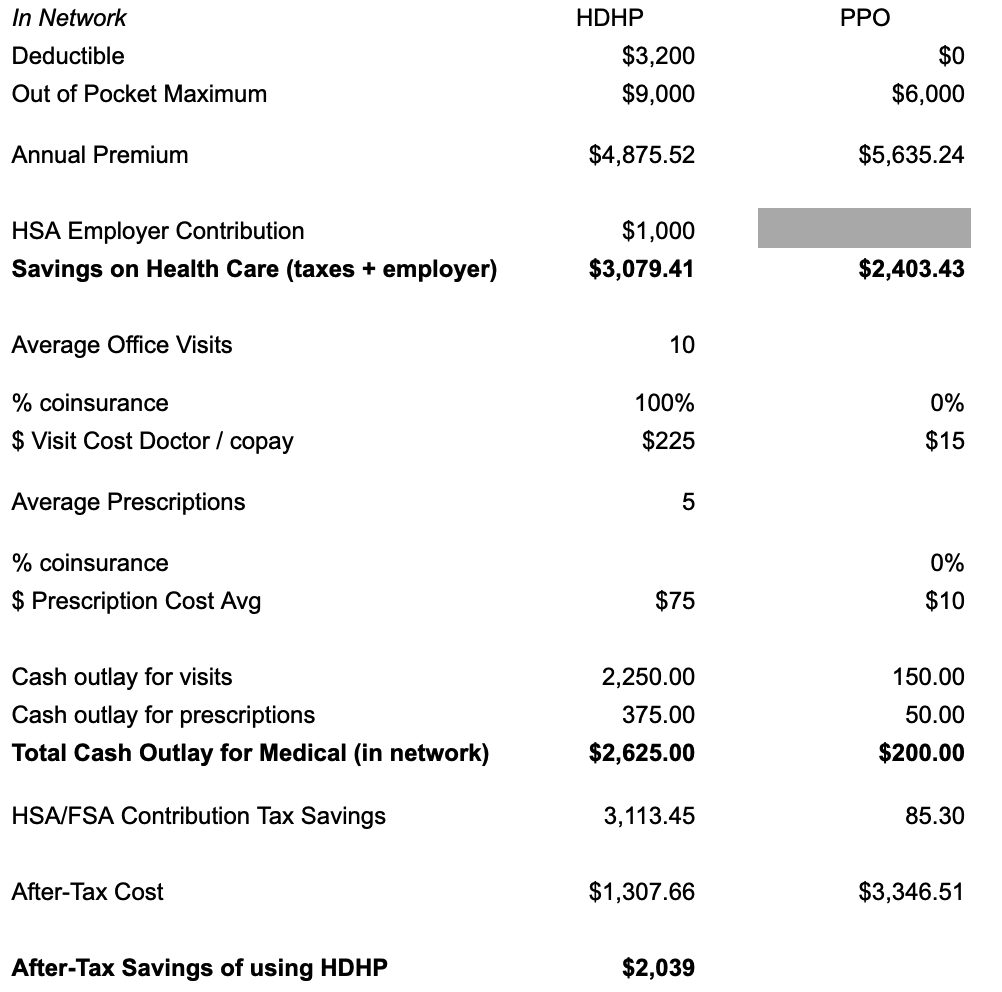
Let’s use the example of a family at the 35% tax bracket in income and the employee is 47 years old.  They have excess cash above their expenses each month to use towards medical expenses and maximizing a contribution to an HSA.  Their company provides a $1,000 family contribution to the HSA account.  At this point, they tend to go to the doctor around 10 times a year and need a few prescriptions as things pop up.

First, we gather information on their deductible, out-of-pocket maximum, and premiums.  Then, we talk through available health insurers and whether their current doctors would be considered in-network. If we feel pretty good about the information given, we will create a calculation to understand what the net after-tax cost of each option may be.

In this example we are looking at the tax savings and cash outlays of what are involved under each situation. The actual calculation for you may be very different, but in this example the HDHP means a current year benefit of $2,039 for the family. 

This doesn’t include any long-term growth of allowing the HSA contribution to be invested and untouched for 12+ years.

When does a HDHP not make sense?

There is still a risk that your medical care needs are greater than expected or that you need out-of-network health care. If you travel often and enjoy riskier activities, then that may mean a higher likelihood that the savings of a HDHP do not materialize for you.

It also may not make sense if you do not have the cash available to maximize the HSA and pay for your medical expenses out of pocket.

Reviewing your benefits package is about making your best assessment. You can always change your mind with the next enrollment season 🙂

Did you enjoy reading this article?  Join our newsletter to be notified when new posts are available.

The above discussion is for informational purposes only.  Recommendations are of a general nature, not based on knowledge of any individual’s specific needs or circumstances, and there is no intent to provide individual investment advisory, supervisory or management services.


What tax election should I make at an IPO?

Tax election at IPO

If you have double trigger RSUs and an IPO coming up, you may receive a ‘tax election’ from your company.   This tax election allows you to decide how much you want to have set aside for taxes on your vesting RSUs at the time of IPO.

For the purposes of this conversation, we will hit on why you might want to choose one tax withholding option over another.

Why do I need to make a tax election at an IPO?

Remember, tax withholding ≠ taxes due.  Tax withholding is a required high-level estimate of taxes that needs to be paid into the IRS throughout the year.  Even if it feels like you’ve paid a lot in tax withholding, you may still owe more at tax time.

Do you want a refresher on double trigger RSUs and an example of the tax breakdown? Check out our post What are Double Trigger RSUs and how are they treated?  

Should I choose to withhold 22% or 37% in Federal taxes from my IPO vesting?

It depends.  How much you withhold for taxes depends on how you want to think about your stock and what your total income for the year will be.  

Some individuals view 37% withholding as ‘leaving gains on the table’ for shares that *could have* appreciated.   Some individuals view 22% as being a big risk that they may have to sell more shares to cover a tax bill if the stock price goes down.

We encourage you to consider this using examples of what that risk might be for your own situation.

Examples of taxes at an IPO

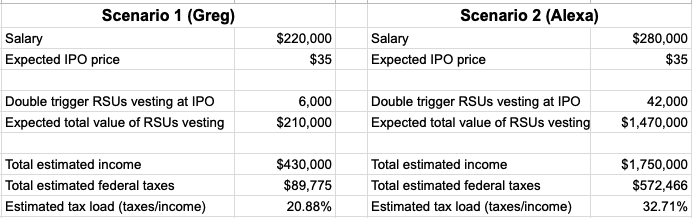
Let’s choose two situations.  The first scenario is for Greg and the second scenario is for Alexa.  We assume that both Greg and Alexa have families and are expecting an IPO to happen at year end.  This IPO will help them each with buying their next home and getting closer to financial independence.  The biggest difference between them is that Greg started at the company as an IC and Alexa came on as a Director.  What could their taxes look like?

Example of tax withholding on RSUs at IPO

By estimating what their total income for the year will be and the taxes due, we can get an idea of what their estimated tax load (aka ‘effective tax rate’ may be).

Other considerations for estimating taxes

Some bigger pieces we are leaving out of these examples are:

If your salary is low, chances are your withholding on your salary is much lower than needed at the IPO.  Salary withholding tables were made by the IRS assuming your salary is your main income.  It matches tax withholding requirements with that income expectation.  If both spouses are working, this effect is magnified.

If you have ISOs or NQSOs to consider, the math gets way more complex.  We recommend working with your tax advisor or financial planner to create the best strategy for you.

Other sources of income may change the math as well. If you do consulting on the side, have other IPOs in the same year (yes, this has happened to our clients in the past!), or long term rentals, then you will need to up your estimate.

Now let’s see how the 22% and 37% tax withholding election could work out for them.

Examples at 22% tax withholding

This is where total estimated income and the effective tax rate matter.  Let’s break down the withholding made a bit further between salary and the RSUs vesting at an IPO.

22% tax withholding on RSUs at IPO

In this case, the difference in total income makes a huge difference in how much more they will still owe come tax time.  Greg may view the risk of $10,000 needed in cash to cover the shortfall as ‘worth the risk’ or up his withholding in case the stock price drops.  Alexa’s shortfall could be catastrophic if she isn’t ready to pay $200,000 at tax time.

What are the downsides to taking on the risk of lower tax withholding?

This comes down to what you can afford to take risk wise and what you can’t.  Greg may have $10,000+ in cash savings annually and see this as a high risk/high reward worth electing the lower 22% tax withholding for.

Alexa may not have $200,000 laying on the sidelines to pay her taxes with.  Even more importantly, what if she did??

Each IPOing employee in this situation should ask themselves: 

1. If you sell more for withholding now and it goes up, how would you feel?

2. If you don’t sell enough to cover taxes now and it goes down, how would you feel?

In Alexa’s case, how would she feel paying $200,000 in to cover taxes only to see the stock tumble?  If the answer is 🙁, then Alexa should select 37% withholding.

Another consideration is the lockup period.  Most IPOing companies have a 180 day lockup period (with some caveats).  I don’t have data on how IPOs tend to look 6 months out, but there is a great study at NASDAQ on what happens to IPOs over the long run.  Long term, the majority of IPOs do not perform well and drop below their IPO price.  This is something to consider in your risk assessment.

Examples at 37% tax withholding

What would happen in each of these scenarios at 37% withholding?  Each would end up with a refund after filing their taxes.  

37% tax withholding on RSUs at IPO

I like to think of this as selling some shares at the IPO price – because that is effectively what will happen.  🙂

Through these two examples, you now have an idea of what a 22% tax withholding rate vs 37% tax withholding rate might mean for you.  The important thing is that you know what to expect – uncertainty and big tax bill surprises can take the fun out of your Company’s IPO.  

Interested in learning more?  Sign up for our newsletter

The above discussion is for informational purposes only.  Recommendations are of a general nature, not based on knowledge of any individual’s specific needs or circumstances, and there is no intent to provide individual investment advisory, supervisory or management services.