
How to Choose the Right Student Loan Repayment Plan

student loan repayment

Student loans often begin as a doorway…an investment in possibility, growth, and a future you’re working hard to build. But over time, they can become unnecessarily complex, shifting constantly, and harder to navigate than they should be.

This blog is about understanding how this piece of your financial life fits into the whole of your life, and making decisions that feel steady, informed, and aligned with your goals. Here is how to navigate each stage with clarity.

Before Graduation Day

Your greatest asset in this season is one you might not realize you have: time. A few intentional steps now can reduce friction later and help you step into repayment with more confidence.

  1. Start with bringing everything into view. Know what you owe, to whom, and under what terms. Federal and private loans are very different, and those differences matter.
  2. Understand your grace period. For many Federal loans, there’s a six-month window before payments begin. Not all loans follow the same rules, so it’s worth confirming the details.
  3. If you’re stepping into a new role, look beyond salary. Some employers offer student loan support or retirement matching that can meaningfully shape your strategy.

This time is about preparation and removing uncertainty.

The Grace Period

The first 6 months after graduation is known as: the Grace Period. Similar to when you first started college, these months are often full in more ways than one… new routines, new responsibilities, and a shifting sense of identity. Your loans are present (and accruing interest), but they don’t need to dictate urgency. This is a window to decide how you want to approach them.

Tip: Most servicers offer a 0.25% interest rate reduction for enrolling in automatic payments.

Private Student Loans

Private loans tend to be more rigid. It’s important to understand if the interest rate on your loans is fixed or variable. A fixed interest rate means your payment stays constant over the life of your loan. A variable interest means your payment will fluctuate as interest rates move up and down. Additionally, if you have a co-signer on your loans, it’s important to check your contract for a co-signer release clause. Knowing exactly how many on-time payments are required to remove them can protect your relationships and their credit.

Tip: If rates are high, prioritizing these loans may bring more long-term ease.

Federal Student Loans

Federal loans offer more pathways, but also more complexity. Some plans prioritize consistency with fixed payments, clear timelines, and a defined end point. Other plans prioritize flexibility with payments that adjust with your income, and the possibility of forgiveness over time.

Neither is inherently better. The right choice depends on what matters most to you right now –  predictability, flexibility, or a longer-term strategic outcome.

And if public service is part of your path, there are additional opportunities worth understanding early to work towards the 120 month forgiveness goal.

Tip: If you are pursuing loan forgiveness, payments made during your grace period do not count toward loan forgiveness.

Choosing a Repayment Path

So, how do you choose a repayment plan for your Federal student loans? Let’s first review the different repayment plan types.
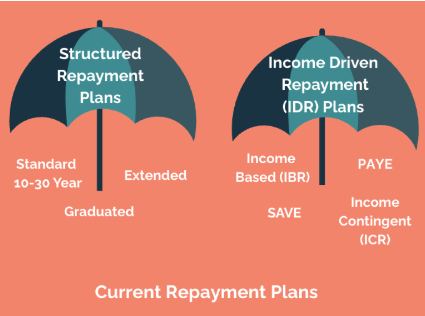
student loan repayment play types

Structured Repayment Plans

Structured Repayment Plans keep a constant payment for a certain period of time. There are 3 types:

  • Standard: Loans default to a standard 10 year repayment period. You can increase the repayment period up to 30 years by consolidating your loans. Your monthly payment stays constant over the life of the loan. 
  • Graduated: Loans default to a 10 year repayment period. You can increase the repayment period up to 30 years by consolidating your loans. Your monthly payment starts low and increases every two years over the life of the loan.  If you are starting in an entry-level role, but you expect your salary to jump significantly every few years, this plan matches your payment to your rising career trajectory.
  • Extended: You must have over $30,000 in Federal student loans to qualify for this plan. The repayment term is 25 years and you can choose either a fixed payment amount or graduated. If you need to keep your monthly payments as low as possible to afford a mortgage or other life goals, this provides breathing room.

Income-Driven Repayment Plans

Income-Driven repayment plans allow you to keep payments low when income is low while also working towards loan forgiveness over time. To be eligible for the separate Public Service Loan Forgiveness (PSLF) program, you would typically enroll in an Income-Driven repayment plan. All Income-Driven repayment plans calculate your monthly payment based on your Adjusted Gross Income (AGI), NOT your student loan balance.

As of May 15, 2026, there are four different Income Driven Repayment Plans. However, this area is changing quickly, and available options may depend on loan type, borrower status, and implementation timing. 

  • IBR (Income Based Repayment): Eligible loans include Direct Federal loans, Grad PLUS loans, and FFEL loans. Any unpaid interest on your loan accrues. Loan balances are forgiven after 25 years (if you borrowed before July 1, 2014) and 20 years (if you borrowed on or after July 1, 2014). Any loan balance forgiven is included as taxable income in the year of forgiveness.
  • PAYE: Eligible loans include Direct Federal loans and Grad PLUS loans. To be eligible, you cannot have any outstanding loans with a loan date prior to October 1, 2007. Any unpaid interest on your loan accrues. Loan balances are forgiven after 20 years. Any loan balance forgiven is included as taxable income in the year of forgiveness.
  • ICR (Income Contingent Repayment): Eligible loans include Direct Federal loans, Grad PLUS loans, and consolidated Parent PLUS loans. Any unpaid interest on your loan accrues. Loan balances are forgiven after 25 years. Any loan balance forgiven is included as taxable income that year.
  • SAVE: SAVE is being phased out, and new enrollment is not available. Borrowers currently enrolled should monitor Department of Education and servicer updates before switching plans, because changing plans may affect payment amounts, interest treatment, and forgiveness strategy. 

Tip: Federal repayment options are scheduled to change beginning July 1, 2026 for new borrowers. Current borrowers may have different rules depending on their loan type and repayment plan, so confirm available options through StudentAid.gov or your servicer before making changes. 

So back to how, do I choose a repayment plan?

Flexibility: If your priority is flexibility, income-driven plans can offer breathing room when income fluctuates and possible loan forgiveness.They ask for ongoing attention since they require annual income and family updates, but in return provide flexibility.

Consistency: If your priority is consistency and simplicity, structured plans offer steady payments, fewer moving parts, and a clear payoff timeline.

Public Service Loan Forgiveness: If you are interested in Public Service Loan Forgiveness (PSLF), you must be enrolled in an Income-Driven Repayment plan and work full-time for an eligible government employer or not-for-profit organization. It’s important to note that PSLF forgiveness is a separate forgiveness path than Income-Driven forgiveness.

The real question isn’t simply what saves the most money. It’s what creates the most stability and alignment for you.

Federal Student Loans: Who Does What?

We are frequently asked between your loan servicer (Mohela, Nelnet, Aidvantage, etc.) and the Federal government (studentaid.gov), who does what? Here is a list of duties for each (although, this is subject to change with the dismantling of the Department of Education):

A common question we receive is about the different roles of your loan servicer (such as Mohela, Nelnet, or Aidvantage) versus the Federal government (via studentaid.gov). Below is a list of duties for each, though keep in mind this is changing with the shifts in the Department of Education.
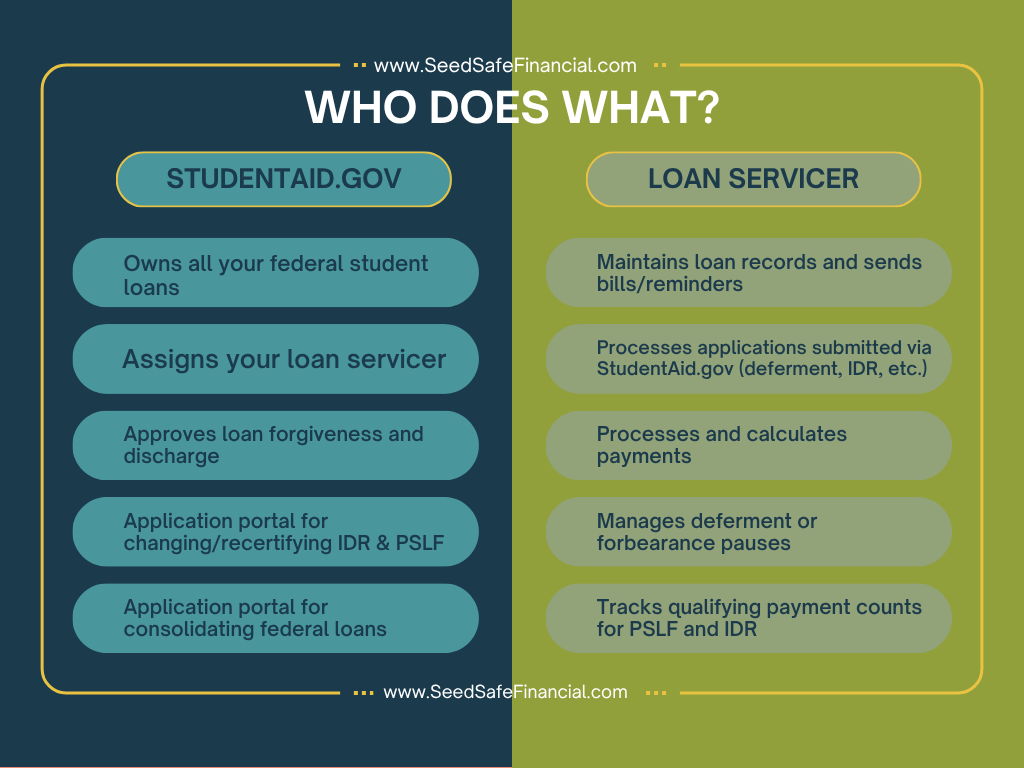
Who to reach out to for student loan repayment

As Your Life Evolves: Refining the Strategy

A year or two into your career, your relationship with money often shifts. Income grows. Priorities deepen. Life becomes more layered. This is where autopilot is no longer enough and optimization begins.

Private Student Loans

Refinancing private student loans is an ongoing option for lowering your monthly payments. As you build credit and interest rates fluctuate, shopping around for better rates could save you. Since student loan refinancing typically involves no origination fees, it is always worthwhile to compare offers, and you can continue to refinance if lower rates become available in the future.

Federal Student Loans

If you’re on an Income-Driven Plan, you must recertify your income and family size annually. Do not miss this deadline. If you do, your payments may jump back up to the higher Standard Plan amount. If you are married, it may be beneficial to speak with an accountant to determine the trade-off in filing taxes separately if it lowers your student loan payment. 

If you qualify for PSLF, submit your Employment Certification Form annually. 

If you have extra cash flow, you face a meaningful choice: accelerate repayment or direct those dollars toward investing and other goals

If you qualify, you may be able to deduct up to $2,500 in student loan interest paid on your Federal tax return. This is subject to income phase-outs and, if you are married, you must file Married Filing Jointly.

If refinancing becomes an option, it deserves careful consideration. Lower rates can be attractive, but federal protections, once given up, cannot be regained. Generally, Federal student loans offer greater consumer protection than Private student loans:

  • More flexible repayment options
  • Forgiveness programs
  • Pauses related to deferment or forbearance
  • Loan Rehabilitation
  • Loan Consolidation
  • Loan discharged upon death

There’s no one-size answer here. It’s a decision that lives at the intersection of math and meaning.

A Final Thought

Student loans don’t exist in a static system. Policies change, programs evolve, and what was true a decade ago may not hold today. This doesn’t mean you need to react to every headline, but it does mean your strategy should be revisited as the world shifts around you.

The landscape is currently undergoing one of its most significant transformations in decades. Following the One Big Beautiful Bill Act passed in 2025, we are moving toward a more streamlined, but very different, repayment system starting July 1, 2026.

The goal is to remain steady and responsive. This blog reflects what we know today, but because the guidance is still evolving, we will be posting an update during Summer 2026 as the final rules are implemented. Because repayment-plan availability and forgiveness eligibility, are still being updated, start by verifying your options through StudentAid.gov, your loan servicer, or a qualified advisor before changing repayment plans. The best strategy is to stay informed and proactive. Commit to revisiting your student loan strategy annually to be sure it aligns with your income and goals.

Sources:

Studentaid.gov: Managing Repayment Plans

Student Loan Borrower: Dealing with Student Loan Debt

Congress’ Most Recent Bill on Repayments

Disclaimer: 

This material is provided for informational and educational purposes only and does not constitute legal, tax, or investment advice. The strategies discussed may not be appropriate for all individuals or situations. Eligibility and suitability depend on your specific circumstances, financial objectives, and current laws, which are subject to change.

SeedSafe Financial, LLC provides tax preparation and planning services for advisory clients; however, this material is for educational purposes only. Transmission of this information does not create a client-preparer relationship. Please consult with your SeedSafe advisor or a qualified tax professional before implementing these strategies.

Employer plan provisions, contribution limits, and benefits may vary by company. Confirm specific plan details directly with your employer or benefits administrator.

Any examples are hypothetical and provided for illustrative purposes only. They do not represent actual client outcomes, and results will vary. You should consult with qualified tax, legal, and financial professionals before making decisions related to the topics discussed.

References to third-party resources or websites are provided for informational purposes only. SeedSafe Financial, LLC does not endorse or assume responsibility for the accuracy or completeness of external content.

Advisory services are offered through SeedSafe Financial, LLC, an SEC-registered investment adviser. Registration with the SEC does not imply a certain level of skill or training.

Backdoor Roth IRA 2025: How It Works, Why to Use it, and Tax Considerations

backdoor Roth IRA

The Backdoor Roth IRA is a strategy that enables high-income earners to make Roth IRA contributions indirectly when their income exceeds the limits.  Why do they care?  High earners benefit from high cash savings and a Roth IRA allows a greater contribution towards retirement.  Funds in a Roth IRA grow tax-deferred and may be eligible for tax-free distributions in retirement.  A Roth IRA can be an effective tax strategy for managing tax brackets in retirement and a legacy planning tool.  So how can you benefit from this strategy anyways?  Insert -> the Backdoor Roth IRA strategy.

What is the Backdoor Roth IRA?

The Backdoor Roth IRA is a tax strategy that helps high-income earners contribute to a Roth IRA when they’re over the income limits (in 2025, $165,000 for single filers and $246,000 for married couples) by contributing to a traditional IRA and then converting it to a Roth IRA.

First, you make an IRA contribution (up to $7,000 in 2025 for those under 50 years old and $8,000 for those over 50 years old) by April 15th 2026.  Then, you can convert this IRA contribution to a Roth IRA.  Over time, the Roth IRA compounds and becomes a valuable addition to your retirement savings. 

Who Should Consider a Backdoor Roth IRA?

If you are:

  • Above the income threshold for a Roth IRA contribution
  • Have extra cash during the year and want to save towards retirement
  • Are willing to take the steps to set yourself up for a successful Backdoor Roth strategy

When a Backdoor Roth Makes Sense

At SeedSafe Financial, we work with tech professionals who want to get out of the game by their 50s.  The Backdoor Roth strategy can be a great way to increase retirement savings.

Many of our tech clients have excess cash from IPOs or large amounts of RSUs – their taxable investments often dwarf retirement savings.  This strategy reduces the taxable impact of investing while they are in higher tax brackets.

We also use this for clients who want to leave money to their children when they pass.  At this time, a Roth IRA can be passed down to your children with minimal tax impact.  For more advanced estate planning, a Roth IRA with a Trust beneficiary can be helpful.  Trusts that hold IRAs and Roth IRAs must take distributions on a reduced timeline than if left to children.  The Roth IRA reduces the tax impact of the required distributions while still maintaining control over when the kids get the money.

Step by Step:  How to Do a Backdoor Roth IRA

*Warning: keep reading below before you follow these instructions for the mistakes to avoid*

The Backdoor Roth IRA strategy is not for the faint of heart – it takes time and diligence to make sure you enact it correctly:

  1. Open a Traditional IRA at your custodian of choice
  2. Make a ‘non-deductible’ IRA contribution for the year
  3. Invest it and wait a bit to convert it
  4. Open a Roth IRA account at the same custodian
  5. Call the custodian and ask to convert the Traditional IRA to the Roth IRA account
  6. Report the conversion on IRS Form 8606
  7. Repeat annually
  8. Keep track of your basis in each the Traditional IRA and Roth IRA in case of future legislative changes

And there you have it! You’ve completed the steps for a Backdoor Roth IRA! 

Understanding the Tax Implications

Here comes the tricky part – because there is always a catch when the IRS allows you to do something like this.  The Pro-Rata rule.

What is the Pro-Rate Rule?

The Pro-Rata rule in Roth IRA conversions is an additional wrinkle to consider.  If you have pre-tax IRA money and non-deductible contributions in one account, the conversion will be partially taxable.   An example of pre-tax IRA money is if you rolled a past 401(k) into your IRA.

Why does this happen?  You are making a ‘non-deductible’ IRA contribution.  A non-deductible IRA contribution means you are over the income limits to be able to deduct this amount on your tax return.  So you are making a contribution ‘post-tax’.  When you make a ‘post-tax’ contribution, it has a cost basis similar to when you purchase taxable investments.   This cost basis in the IRA is not taxable in a conversion.  However, anything pre-tax is.

Let’s look at an example:  Dave rolled his 401(k) from a past employer to a Traditional IRA in the amount of $500,000.  A few years later, Dave decides to start making an annual non-deductible IRA contribution.  He forgets to convert it for a few years and now his Traditional IRA is at $600,000 in total with $21,000 in basis from non-deductible IRA contributions.   If he decides to convert the $21,000 now, the IRS will tax part of it as income.

($600.000 – $21,000) / $600,000 = 96.5%

96.5% of the $21,000 = $20,265 taxable income in the year of conversion

That was not what we wanted to happen from a tax efficiency standpoint.

So how do you fix this issue?  If you are still employed, we often suggest rolling the pre-tax amount back into your 401(k).   Then, with just the $21,000 in your Traditional IRA, the result will be very little taxation at conversion.

Disclaimer: This example is hypothetical and provided for illustrative purposes only.

Common Mistakes to Avoid

Based on the above conversation, there are certainly a few mistakes you can easily make:

  • Having a mix of pre-tax and non-deductible funds in your Traditional IRA account
  • Forgetting to file the Form 8606 when you make the conversion (to track your non-deductible contributions and basis)
  • Doing the conversions too quickly and running into the IRS substance test.  Aka, if it looks like a Roth IRA contribution and smells like a Roth IRA contribution, it is.
  • Not tracking your Traditional IRA basis on an ongoing basis with your tax return 

Backdoor Roth IRA vs. Mega Backdoor Roth

Is there an easier or better way to do this?  Many of our big tech clients at Google, Amazon, Apple, Meta, Microsoft and their portfolio companies have the option of an ‘After-Tax 401(k)’.  This is included in their 401(k) company benefits and will show up in the contributions area for the plan.

The After-Tax 401(k) allows you to make a Mega Backdoor Roth Contribution!  We detail out this strategy and the benefits on our blog post Is a Mega Backdoor Roth Strategy Worth It?  The Mega Backdoor Roth is a Backdoor Roth on steroids – a higher contribution amount and less complication with the pro-rata rules.  

Summary FAQs About the Backdoor Roth IRA

  1. Is the Backdoor Roth IRA still legal in 2025?

Yes. The Backdoor Roth IRA remains legal and IRS-approved in 2025. No current legislation has eliminated this strategy for high-income earners.

  1. Who should use a Backdoor Roth IRA?

It’s best for high-income earners who exceed Roth IRA income limits ($165,000 single / $246,000 joint in 2025) but want tax-free retirement growth.

  1. What is the Pro-Rata Rule?

If you hold both pre-tax and after-tax IRA funds, the IRS taxes conversions proportionally. Rolling pre-tax funds into a 401(k) can help avoid extra taxes.

  1. What’s the difference between a Backdoor Roth and a Mega Backdoor Roth?

A Backdoor Roth uses an IRA; a Mega Backdoor Roth uses after-tax 401(k) contributions to convert much larger amounts – up to roughly $70,000 per year.  This limit includes your employee contribution (up to $23,500 in 2025) + employer match + after-tax 401(k) = $70,000 max.

  1. Can I do a Backdoor Roth every year?

Yes. As long as conversions are allowed, you can complete a Backdoor Roth annually and track it with Form 8606.

At SeedSafe Financial, we believe wealth isn’t just about saving – it’s about strategy. The Backdoor Roth IRA can be one of the simplest ways to grow tax-free wealth and build a lasting legacy. Ready to see how it fits into your plan? Let’s make your money move with purpose.

Thinking about other year end strategies or going through benefits enrollment?  Check out our other blog posts:

Disclaimer:
This guide is provided for informational and educational purposes only and does not constitute legal, tax, or investment advice. The strategies discussed, including the Backdoor Roth IRA, may not be appropriate for all individuals or situations. Eligibility and outcomes depend on many factors, including your personal financial situation and current federal and state tax laws, which are subject to change.

Any examples provided are hypothetical and for illustrative purposes only. They do not represent actual client outcomes, and actual results will vary. You should consult with qualified tax, legal, and financial professionals before taking any action related to Backdoor Roth IRAs or any other tax planning strategies.

Is a Mega Backdoor Roth Strategy Worth it?

Is a Mega Backdoor Roth Strategy Worth it?

If you’ve joined the tech industry in the last 5 years, you’ve seen a huge adoption of the ‘after-tax 401(k)’.  The after-tax 401(k) is an employee benefit that allows you to put more money away for retirement and implement the Mega Backdoor Roth strategy.  We see this often available for our clients at larger tech companies like Amazon, Google, and Microsoft.  

There are many articles on what a Mega Backdoor Roth is, but fewer that explain why you should do it and how to do it.

If you’re considering whether this strategy is worth it for you, below is a detailed look at what it is, the benefits, and potential pitfalls.

What is a Mega Backdoor Roth IRA?

First, a quick breakdown of how the Mega Backdoor Roth strategy works. Essentially, it’s a way to convert after-tax 401(k) contributions into a Roth IRA. Here’s how it works:

  1. In your 401(k) portal you will have the option to contribute pre-tax, Roth, and/or after-tax.  Contributions to pre-tax or Roth are the usual ‘employee contribution’ we’ve seen available in 401(k) plans for a long time.  For these contributions, the maximum total amount you can add to it is $23,000 in 2024 (or $30,500 if you are age 50 or older).  An additional benefit is the after-tax 401(k) contribution.
  2. After-Tax Contributions: The limit on after-tax 401(k) contributions is up to the overall 401(k) limit of $69,000 (or $76,500 if you’re 50 or older).   
  3. Maximum After-Tax Contributions:  This varies from employer to employer.  The overall 401(k) limit applies to how much you can contribute.  The overall limit includes your regular employee contribution, your employer contribution, and any after-tax 401(k) contribution.  This means how much your employer contributes may change the total amount you can set aside in the after-tax 401(k).
  4. In-Plan Roth Conversion or In-Service Withdrawal: These after-tax contributions can be converted to a Roth 401(k) or rolled over to a Roth IRA.  Once rolled to a Roth and invested, they can grow tax-free.  However, this is usually an election you need to make within your 401(k) portal.   I’ve seen this missed by employees at Google, Amazon, etc where they thought selecting the after-tax 401(k) option was all they needed to do.  Don’t forget to click that ‘Convert to Roth’  button 🙂

Benefits of a Mega Backdoor Roth IRA

  • Tax-Free Growth: Once the funds are converted from the After-Tax 401(k) to a Roth account, they grow tax-free. This can add significant tax savings, especially if you have a long investment horizon before you take distributions.
  • High Contribution Limits: The ability to contribute up to the overall 401(k) limit generally means you can put $40,000+ towards the strategy.  This is far beyond the regular Roth IRA limits of $7,000 (or $8,000 if you’re 50 or older).
  • Flexibility in Withdrawals: Your Roth IRA does not have a ‘required minimum distribution’ (RMD) during your life.   This means more flexibility in retirement planning.
  • Inheritance Planning:  With the new inherited IRA rules post-2020, all assets in the Roth IRA must be distributed within 10 years following the original owner’s death (or 5 years for beneficiaries that are trusts and other situations).   This means if you have a large IRA balance at death, then your beneficiary may recognize more income over those 10 years.  This can result in a higher tax bill.  If you leave a large Roth IRA balance at death, then this new rule won’t impact taxes since distributions are tax-free.  
  • Tax Diversification: A mix of tax-deferred, taxable, and tax-free retirement accounts can provide greater flexibility around taxes in retirement. 
  • High Income Earners: The Roth IRA income limit is $240,000 for married joint filers (or $161,000 for single taxpayers).  This strategy gives you an opportunity to still put money towards Roth accounts.

Considerations and Potential Drawbacks

While the mega backdoor Roth IRA has considerable advantages, it’s not without potential downsides:

  • Cash Flow:  Don’t put the cart before the horse – if you don’t have the buffer in cash flow to enact this strategy things can go sideways fast.  It’s not worth racking up credit card debt to be doing ‘all the cool hacks’.  Get your spending plan right first.
  • Savings Strategy:  Don’t forget to prioritize 401(k) employee contributions and HSA contributions first.  (Interested in why we say look at HSAs first?  Find out more here.) If you are healthy and have excess cash flow, there are even greater benefits to looking at these first.  There is certainly a priority list in how to consider your employee benefits 
  • Complexity: You need to make sure you track conversions on your tax return through the years.  Maintaining IRA and Roth IRA basis in your workpapers may be vital if changes in the tax code occur.  If any gains happen between the after-tax 401(k) contribution and the conversion to the Roth IRA, you will receive a Form 1099-R to add to your tax return.
  • Immediate Tax Impact: The conversion of after-tax contributions to a Roth account can have immediate tax consequences on any earnings from the after-tax contributions.  This is why clicking the button to allow in-plan conversions is vital!

Is It Worth It?

The decision to use a mega backdoor Roth IRA strategy depends on several factors:

  • Your Financial Goals: If your goal is to maximize tax-free growth and you have the means to contribute significant amounts to your retirement savings, this strategy can be highly beneficial.
  • Early Retirement:  If your goal is to get out of the 9-to-5 game by age 50 or you are still working on financial flexibility, this may not be the time to lean in.   Make sure you are focusing on the right mix of investment vehicles that will get you there.  Locking up every-last-dollar into retirement accounts may not be for you.
  • Plan Features: This strategy works best when the after-tax 401(k) allows for in-service withdrawals to minimize the tax bite.
  • Current and Future Tax Brackets: Consider your current tax bracket versus your expected tax bracket in retirement. If you expect to be in a higher tax bracket later, paying taxes now on conversions may be a good idea.  For our California clients, many need a $5 to $10 million investment portfolio to fully lean into financial independence.  This means their future tax bracket on investment income will have a huge impact.
  • Comfort with Complexity: This strategy requires a solid understanding of tax rules and reporting on your tax return. If you’re comfortable with these aspects or have a financial advisor to guide you, it can be a worthwhile endeavor.  

Conclusion

The mega backdoor Roth IRA is a powerful tool for those looking to significantly boost their retirement savings and benefit from tax-free growth. However, it’s not suitable for everyone. 

  1. Make sure you know how to enact the full strategy
  2. Review your finances to know where it fits in your spending/saving plan and long term goals
  3. Consider bringing in an expert to help you decide what will help you reach financial flexibility faster and give you a roadmap to financial independence

If you are still on the hunt for the right financial advisor for you, schedule some time with us to see how we can help grow your wealth.  Find out more about our team here.

The above discussion is for informational purposes only.  Recommendations are of a general nature, not based on knowledge of any individual’s specific needs or circumstances, and there is no intent to provide individual investment advisory, supervisory or management services.


What should I do if my startup announces a tender offer?

startup tender offer

What does it mean for my startup to have a tender offer?

A tender offer is a startup’s way of providing liquidity to employees and offering shares to others.  Often we see this start to happen as the company gets closer to IPO or decides to delay IPO.  In part, this helps employees see the value of their hard work and in part helps the company provide stock to potential investors.

Generally, we see startup tender offers limited to a maximum of $X or Y% per person.  The more common caps we’ve seen are up to $1 million in value or 50% of stock outstanding.  This is because tender offers are generally fueled by investor money or profits and so there is a total cap.  If the tender offer is ‘oversubscribed’, that means there is more demand for tendering shares for cash than can be fulfilled.  In this case, your total request of shares to be bought back may be further limited.

Review your personal financial situation to decide whether participating in the tender offer is right for you.  

  • Are you hoping to buy a new home?
  • Are you expanding your family and want to get a head start on college funding?
  • Will you be leaving the startup soon and need to plan for a potential clawback?
  • Do you want to exercise more stock options and are facing a cash crunch?
  • Do you want to diversify out of your startup stock a bit for future flexibility?

There are many opportunities in selling back some shares in a startup tender offer.  Other questions can be found in our tender offer basics post.

What should I consider during a tender offer?

  • Why is the company doing a tender offer?  Is this an opportunity for investors to get in when they believe the stock is undervalued?  Or is this to provide liquidity while waiting for IPO/M&A?
  • What is the valuation the shares are being offered at?  If the shares are ‘underwater’ i.e. under the exercise price for options or RSU vesting price, you may feel differently about tendering the options.  Generally, there is no reason to tender stock options under the exercise price.
  • How do I feel my company is doing?  Are you surprised at the valuation?  Do you see a long road ahead for the company?  Or do you feel the company is at a lower point now with the right metrics to get it to an even better Series XYZ in a year or two?  Although your assessment is biased, it is something to consider and weigh the risk / reward of keeping more shares.  I like to ask the question as: If you had the value of what you expect from the tender offer in cash, would you buy company stock with it?  
  • What are the tax implications?  Each type of stock option and currently held share may have different tax implications in a tender offer. 
  • Which experts are in my corner to make sure I am considering the implications?  Consult with your financial advisor or tax advisor to plan for the best outcome.  If you are looking for guidance, schedule some time with us to think through options HERE.

What are the tax implications in tendering my shares?

  • Unexercised stock options:  the difference between the sales price and exercise price will be treated as ordinary income (compensation)
  • Exercised ISOs:
    • If held short term or less than 2 years from grant date, this would disqualify the special tax treatment and turn it into an NQSO sale.  We rarely recommend doing this since you may have already paid AMT taxes at exercise and will not be able to get a credit back.  This will be treated as ordinary income (compensation)
    • If held long term, this will result in long term capital gains/losses
  • Exercised NQSOs:  short term or long term capital gains/losses
  • Vested RSUs:  short term or long term capital gains/losses
  • Unvested RSUs:  these are generally ineligible for tendering

Beyond what type of income or gains/losses each type of stock will be, there is also the question of who is paying any taxes due to the IRS and state tax department.  We suggest reviewing your paystub post-tender offer to see what came through the paystub vs. what did not.  You will be liable for the taxes in the end, so it is better to know now than when you file your tax return.

Is a tender offer better than an IPO?

Startup tender offers can be rewarding and less stressful.  Instead of watching the market daily while you wait out your lock up period, a tender offer allows you to review your finances with a known price.  It is a great way to financially profit while waiting for an IPO or Merger to happen “one day”.

I love it when a long-time startup employee comes to us with RSUs and ISOs in a tender offer.  Then, we work together to find the best strategy based on their situation.  Our goal is to understand where you want to be financially and keep it front in center.  Then, we balance tax implications, risk exposure, and long term growth at a level you are comfortable with.

For many of our clients going through tender offers with RSUs and ISOs we are able to purchase ISOs, minimize AMT taxes and diversifying out a large portion of cash from the event.  This makes my heart sing for my clients!

Can a startup force a repurchase of shares?

This is often called a ‘Clawback provision’.  If a startup includes a clawback in the plan documents, the company may be able to repurchase shares at termination or in the case of an exit.    Typically, the buy back will be at the fair market value of the shares at that time and can prevent you from realizing the full value of owning the shares.  

An example of the downside of clawbacks can be seen in the Skype acquisition by Microsoft.  Read more about it HERE and see some in depth examples HERE.

Another example of a clawback in action is if you make an 83(b) election and leave before your shares fully vest time-wise.  The company typically has 90 days to repurchase any of your unvested shares at the same price you paid. 

Those are the most common examples of a forced buy back, but not something we commonly see occur as part of a tender offer.

In the end, the best plan for a startup tender offer is the one where you decide how this event can get you closer to your financial goals.

If you are looking for a thinking partner in how to optimize and streamline your finances, schedule some time to chat with us.

Interested in learning more?  Sign up for our newsletter

The above discussion is for informational purposes only.  Recommendations are of a general nature, not based on knowledge of any individual’s specific needs or circumstances, and there is no intent to provide individual investment advisory, supervisory or management services.


Should I opt into the Google Employee Trading Plan?

Google Employee Trading Plan

The Google Employee Trading Plan is a 10b5-1 plan that allows you to set up a trading program outside of the annual trading windows.  It also helps alleviate the pressure to sell at the right time or to need to make a decision every time the stock vests.

The trading plan starts with a cooling off period where you cannot sell stock for a few months and then goes into action in August.  The plan will continue until July the following year.

There are many options within the Google Employee Trading Plan for selling prior vested GSUs and future vestings (starting with August).  If you do decide to sell prior vested GSUs, there will be an option of which shares to sell and how to sell them.  Two of those options are FIFO and LIFO.  FIFO means selling the shares you first received long ago and still hold.  This will sell long term held GSUs.   LIFO will sell shares most recently vested.  Prioritizing recently vested shares may result in short term capital gains that are taxed at higher tax rates.

What should I consider?

When you are thinking about whether to opt into the plan, a few factors to consider are:

  • Company performance
  • Stock volatility
  • Need for diversification
  • Trading plan restrictions
  • Your financial plan

Below are a few of the thoughts we take into consideration of our clients when reviewing whether the plan is helpful for them.

Why opt into the Google Employee Trading Plan?

Company performance:  If you don’t believe in forecasting or don’t know what to expect, then you may want to capture it systemically.  You may also review trends and see that the stock tends to drop after trading windows open for employees.

Stock volatility:  If the changes in stock value makes it hard to sell, you may want to opt in to the trading program to reduce decision fatigue.

Need for diversification:  If the majority of your net worth is from vesting GSUs, then you may wish to diversify your portfolio or add liquidity.  Trading windows would restrict when you could use the money.

Trading plan restrictions:  If you live in a more expensive place, you may need to use some shares for mortgage payments and living expenses.  A trading program using VWAP will allow you to receive the cash from each RSU vesting on a monthly basis to align with your spending and savings.

Your financial plan:  Opting in will allow you to build a snowball of selling shares and putting the cash towards your investments and life goals.  This may mean saving more towards a home, expanding your family, supporting parents, or leaning into investing in owning your time in the future.

Why not opt into the Google Employee Trading Plan?

Company performance:  If you think Google is riding the wave of AI, user growth, and is going to kill it this year, then you may believe in timing a sale.  You may decide to review financial performance and news after each trading window opens up to determine what you want to do.

Stock volatility:  If you prefer to attempt to ‘game’ the volatility and sell on a local high within the trading windows, then you may want more control than a trading plan offers.

Need for diversification:  If you prefer to take the risk of maintaining your career and investment portfolio all with one entity.

Trading plan restrictions:  If you don’t need the shares for living expenses or an upcoming purchase.  Or, you may want the opportunity to change your mind on selling previously vested GSUs through the year.

Your financial plan:  If your financial philosophy is about placing big bets in the hope for big returns and grinding until that point, then you may not see a need to opt in.  Caution: this is more of a speculative decision than a financial plan.

Our recommendation

When you want to streamline your finances and add clarity to your life, a trading plan frees you emotionally and timing wise.  You are able to flex your financial freedom muscles knowing each month you are getting closer to your financial goals and a stable future.  

The employee trading program can be freeing for most financial plans.  You are able to take the compensation you’ve earned and use it towards investing in yourself, your family, and your long term success.

That is our philosophy.  What is yours?  What is money’s purpose in your life?

If you are looking for a thought partner in your financial life, schedule a chat with us.

Interested in learning more? Sign up for our newsletter

The above discussion is for informational purposes only.  Recommendations are of a general nature, not based on knowledge of any individual’s specific needs or circumstances, and there is no intent to provide individual investment advisory, supervisory or management services.


7 Rookie Mistakes Even Your Boss Makes at Benefits Enrollment Time…

Benefits Enrollment

Benefits Enrollment season… that lovely time of year where you have less than a month to get your life together (what changed from prior year?) and still meet all your big year end work deadlines.

Side note: This is one of the things I feel like Amazon did right by having a non-year end enrollment period 🙂 

There are probably 1000s of blog posts on benefits enrollment topics, but sifting through them means you might miss something big.  So instead of restating details on what each benefit means, I’m giving you the short twitter headline and a link to a great blog explaining the topic.  

HSAs

Do you have positive cash flow?  Maxing out your 401(k)? Contribute to an HSA.

Have an HSA?  Not using it much?  Look at investing part of it to make the most of the tax deferral!

https://youngandtheinvested.com/what-is-hsa/

Dependent Care FSAs

Are your kids no longer at daycare?  What about after school care or summer camps?  Might be eligible for this pre-tax benefit.

https://www.fsafeds.com/explore/dcfsa

ESPPs

A forced savings mechanism and a ‘guaranteed’ discount means automatic after-tax value in your pocket.

https://blog.wealthfront.com/good-espp-no-brainer/

Exec Deferred Comp

Okay, I lied, this one is going to be longer than a Twitter headline…

Most of our executives have a ridiculous amount of stock vesting each year through RSUs and NQSOs.  Many are uncomfortable with the tax hit they would take for diversifying their risk. Most deferred compensation plans come with more investment options.  Therefore, some executives can use this to defer 75% of their salary and bonus, then use NQSO exercises/sales to fund their annual expenses. Thus getting out of a concentrated position and into a more diversified investment strategy.

Using your deferred stock plan might be a great way to diversify out of your NQSO concentrated position.  However, it isn’t a fool proof decision. Unless you work at a mega employer that has made commitments to keep these funds as legally safe for you as possible, it may end up not so great.

https://www.nytimes.com/2017/06/30/your-money/should-you-take-advantage-of-a-deferred-compensation-plan.html

Supplemental Life Insurance

Do you need life insurance to cover debts and family needs?  If you are young and fit, there may be a better alternative.  Check the pitfalls and benefits.

https://20somethingfinance.com/should-you-buy-supplemental-life-insurance-through-your-employer/

Critical Illness Insurance

Are you approaching your 50s and not in the best of shape?  If heart problems or cancer runs in the family, this may be a great deal for you.

https://www.thebalance.com/what-is-critical-illness-insurance-4588339

Pet Insurance

This is the time I really wish my dogs could talk.  X-rays, blood tests, oh my! We love our pets but hate the vet bills.

https://www.usnews.com/insurance/pet-insurance/what-is-pet-insurance

May the odds be forever in your favor…

Did you enjoy this post? Sign Up for our newsletter so you won’t miss another article.

The above discussion is for informational purposes only. Recommendations are of a general nature, not based on knowledge of any individual’s specific needs or circumstances, and there is no intent to provide individual investment advisory, supervisory or management services

How to Change your Life with your Bonus

Tech Career

Surprise! You received a little extra cash for the year. What should you do with an unexpected or year-end bonus?

A bonus is an opportunity to start a habit that will change your life for the long-term. Many times, we end up spending bonuses on a present to ourselves for all our hard work. Instead, allocate it toward goals that will pay compounding presents to your future-self!

The top four ways to use your bonus for a present to your future-self are:

  1. Pay down high-interest debt
  2. Fund emergency savings
  3. Fund retirement savings
  4. Invest

Pay down high-interest debt

What defines ‘high-interest debt’? In my mind, this is debt that you don’t pay off on a monthly basis and has a higher interest rate than 8%.

List out your high-interest loans and credit cards, the balances outstanding, and what the interest rates are. Stack the debt by highest interest rate and start hacking away. Doesn’t that feel good?

But here is where the habit part starts. Paying off your debt and keeping it paid off are two different things. If you make the decision to pay off your debt, you should also make the choice to keep it paid off. Take another look at your spending habits and put together a budget to make this good feeling last.

Fund emergency savings

Do you have 3 to 6 months of savings on hand for emergencies only? If you think your credit card limit counts, guess again. Having three to six months worth of savings is vital in today’s economy. You may bounce around from job to job more often or decide you need a sabbatical to check back in with yourself. Not having this money available for breathing space wreaks havoc on your emotional well-being.

Fund retirement savings

Do you have a 401(k)? Are you making the maximum contribution? If not, this is a chance to save for your future self and reduce your taxable income. Cha-ching!

Invest

A lot of articles I read are focused on setting the right tone with budgets and savings. What do you do for your longer term savings goals? Maybe you want to take an international trip in 5 years, provide for your children’s college fund, or invest extra money so you have more options in the future.

Long-term success requires investments in yourself and in the financial markets.

Little tweaks now create huge differences later. The benefits of compounding interest and gains can change your life. Check out our philosophy on long term success HERE.

Schedule a free consultation to see how we can help.

Did you enjoy this post? Sign Up for my newsletter so you won’t miss another article.

The above discussion is for informational purposes only. Recommendations are of a general nature, not based on knowledge of any individual’s specific needs or circumstances, and there is no intent to provide individual investment advisory, supervisory or management services.

3 Steps for Long-Term Budgeting Success

Budgeting Success

Budgeting sometimes feels like a New Year’s goal for weight loss.  “I’m going to stay on top of my budget this year!” “I am going to start tracking my expenses January 1st!”

The truth is, you only have so much time.  Like with weight loss, there is no magic pill but there is a long term sustainable option.  To get to this, I recommend a three stage approach:

Budgeting Step 1:  Manual process – one or two months of inputting every pain-staking expense into a spreadsheet (example here).


This hurts – but only for a short bit!  If you really want to see where every dollar goes, manually categorizing expenses in a spreadsheet is the way to go.  However, a manual process generally isn’t sustainable.  I generally recommend doing this for one or two months to see where your money is going and then switch to a semi-automated or automated format.  

Think of it like visiting the nutritionist or a personal trainer, they want to see a week or two of exactly what you’ve eaten and when.  This helps them, and you, understand your starting point.

Budgeting Step 2:  Semi-Automated process – Mvelopes app or other budgeting app that works for you.  Generally for around 6 months.


Using mvelopes, or a similar service, allows you to connect your bank accounts for automatic feeding in of expenses.  Then you can set categories and assign transactions to those categories.  For categories, you can get into specifics like electricity, water, internet, etc. or have one category of utilities to include these.  I like how easy it is to see where you are with each budgeted category.  I’m using an app right now since having a baby changed our expenses a bit.

Make it fun by setting goals for each expense category and see if you can ‘beat the goal’ by spending less than you budgeted for.

Budgeting Step 3:  Automated process – Mint.com with the ‘Big 3’ categories for long term success.


Category 1:  Home – includes only housing, transportation, utilities and groceries (suggested to be no more than 50% of take-home pay).  These are your semi ‘fixed’ costs – so a lower percentage of take-home pay is even better!

Category 2:  Investments – includes savings, debt payments, and personal investments (suggested to be at least 20% of take-home pay)

Category 3:  Miscellaneous – includes lifestyle choices from gym fees, hobbies, eating out, internet, cable, etc. (suggested to be no more than 30% of take-home pay)

Within Mint.com, you can set ‘rules’ for expenses to automatically flow to these categories.  It will take some time in the beginning, but as you frequent places this will quickly go down to a few updates a month.

Notice yourself spending outside of the budget again? or want to fine tune your budget?  Go back to Step 1 or 2.  This is a sliding step process as you find your needs change.

Budgeting is an important step in building your financial home.

Did you enjoy this post? Sign Up for my newsletter so you won’t miss another article.

The above discussion is for informational purposes only. Recommendations are of a general nature, not based on knowledge of any individual’s specific needs or circumstances, and there is no intent to provide individual investment advisory, supervisory or management services.

RSUs in your investment portfolio

If you receive a large grant of RSUs or company stock, you will have many risks. Risk of termination before vesting, risk of market volatility in stock price, and asset concentration are a few. You will need to decide whether you will keep the stock once vested, or if you prefer to sell the stock at vesting date.
Concentrated Positions
A concentrated position occurs when you have a large amount of your finances wrapped up in one company. This can cause problems by increasing risk in your portfolio, causing tax issues, and liquidity needs. These risks compound if you have a long time horizon for your investment or your tolerance for risk in your financial plan is different.
Holding onto your company stock can leave you very dependent on one company’s success.
Chances are your salary, your 401(k) match, and your stock compensation are all tied to one company. This one company can ‘make or break’ your future financial freedom based on how well they do.
 
Example: If a competing product comes out, this may drop your stock value and require lay-offs longer term. Many smaller tech companies realize this pain when Amazon or Google announce a competing tool. The stock can plummet by 50% within a week.
Example: If a company ends up like Enron or WorldCom, then the drop may even be worse – wiping out your earnings and stock value completely. It may be hard to think this could be your company when we tend to be overconfident when we have an insider perspective on our employer’s prospects.
 
In these price drop scenarios, you may have paid significant taxes on the vested stock already as well.
On the flip side, if you hold on to the shares and the company goes gangbusters, you may also have significant capital gains accruing. Selling the entire position may not be tax-efficient and cause you a different headache.
Diversification
Holding a large position in one company stock exposes you to higher risk of large movements in the stock price from day to day. Diversification is used to help investors choose a portfolio that offers the best return for a given level of risk. Why take on more risk than is necessary to achieve a given level of return?
A diversified portfolio is based on academic research into the disciplines of economics and finance. Research holds that investing in many different asset classes (i.e. emerging markets, U.S. large cap funds, etc) and in many companies within an asset class will reduce your investment risk. This seeks to avoid damaging investment performance by the poor performance of a single company stock or asset class.
 
At SeedSafe Financial we practice diversification for long term success.  Find out more about our investment management services and consider giving us a call.
 
Find out how diversified your portfolio is through our free online tool.
 

Did you enjoy this post? Sign Up for my newsletter so you won’t miss another article.

The above discussion is for informational purposes only. Recommendations are of a general nature, not based on knowledge of any individual’s specific needs or circumstances, and there is no intent to provide individual investment advisory, supervisory or management services.
If you live in a state with it’s own form of state AMT, this further complicates the matter. AMT calculations can be difficult and you may need professional help, such as that of an accountant, tax attorney, or someone experienced in complex tax returns.

Stock Options and the Alternative Minimum Tax

Stock options and the AMT

Alternative minimum tax (“AMT”) is a hard proposition for many tech employees.  When you exercise incentive stock options it increases your net worth, but you don’t actually get any cash.   This puts you in a tough spot for paying any AMT later on.  This is an important topic for start-up tech employees with a stock option plan and it is easy to miss.

Incentive stock options (“ISOs”) are qualified stock options available under a company stock option plan.  They must be held one year from the date of exercise and two years from the date of grant.  Otherwise, they are considered non-qualified stock options (“NQSOs”).  ISOs receive favorable long-term capital gain tax rates upon sale instead of ordinary income rates.  However, in the year you exercise ISOs, you may be subject to the the alternative minimum tax.

A basic discussion of what happens when you exercise an ISO can be found at How to Report Stock Options on Your Tax Return

At year end, your company will report your ISO exercise on IRS Form 3921, per the stock option plan requirements.  The IRS and you will receive a copy shortly after year end.  This form will help you and your accountant complete the AMT calculation for your annual tax return.

What is AMT?

AMT is an alternative tax system that takes your regular taxable income from Form 1040 and makes adjustments for special items.  ISOs are one of those adjustments. The adjustment amount is calculated as the difference between the value and exercise price at the time of exercise.

Other adjustments generally include state and local taxes paid, real estate taxes, interest on home equity loans, etc.  This is a complex calculation and we are discussing a high level view in this post.

This generally results in a higher alternative minimum taxable income (“AMT income”) that is subject to either a 26% or 28% tax in the year of ISO exercise.

When you sell your ISO shares, this will decrease your AMT income for the year of sale and reduce your AMT liability below regular tax.  As a result, the AMT credit produced from the exercise can then be used to recapture a portion of the AMT you previously paid.

When does AMT apply?

The AMT income exemption amount for married filing joint at $133,300 or single at $85,700 (for 2024).  This begins to phase-out for higher earning households at $1,218,700+ joint or $609,350+ for single.

AMT is generally applied to AMT income at a 26% to 28% tax rate.   The tax bracket raises at $206,100 for both married filing jointly and single taxpayers.

Confused yet?  This is why tax accountants and experienced advisors are so important for tech employees!

How do I minimize AMT?

A few ways include:

  • Determine the number of ISOs you can exercise without generating additional AMT liability.  This ‘AMT cushion’ amount  utilizes the difference between regular tax and calculated AMT tax.  If a cushion exists, consider exercising ISOs toward the end of the year when you have a better estimate of taxable income.
  • Exercise ISOs and sell qualified ISOs in the same calendar year.  This ‘ladder’ approach works with ISO exercises over a few years and may significantly reduce the overall AMT you pay over time.
  • Exercise ISOs and exercise NQSOs in the same calendar year.  This will increase taxable income and AMT income at the same time and may reduce the difference under these two tax systems.
  • Use a prior year AMT credit. An AMT credit is a little convoluted in calculating.  In general, this is a credit for the difference between regular tax and alternative minimum tax in the year AMT is paid.  When your regular tax liability is higher than your AMT tax liability, you may use a prior AMT credit against your regular tax liability.

If you work for a public tech company and already exercised ISOs at the beginning of the year, look at the prices again.  You may be able to do something similar to ‘exercise ISOs and exercise NQSOs’ by selling those earlier 2024 exercises and disqualifying them.  When you disqualify an exercised ISO, the stock sale becomes compensation income similar to NQSOs and may open the door for exercising and holding way more shares.  Of course, this also depends on your risk level and what you can personally do based on the market environment and your own emergency needs.

Where are you in your start-up adventure?

Did you enjoy this post? Sign Up for my newsletter so you won’t miss another article.

The above discussion is for informational purposes only. Recommendations are of a general nature, not based on knowledge of any individual’s specific needs or circumstances, and there is no intent to provide individual investment advisory, supervisory or management services.

If you live in a state with its own form of state AMT, this further complicates the matter. AMT calculations can be difficult and you may need professional help, such as that of an accountant, tax attorney, or someone experienced in complex tax returns.  If you live in a state with its own form of state AMT, this further complicates the matter.  AMT calculations can be difficult and you may need professional help, such as that of an accountant, tax attorney, or someone experienced in complex tax returns.