Your Company Is Going Public: How Much Stock Is Enough?

Your Company Is Going Public: How Much Stock Is Enough?

When someone comes to us ahead of an IPO, the conversation often starts with IPO strategies.

What’s the most tax-efficient way to diversify? Should I hedge the position? How much should I sell? Is there a way to defer the gain? How do I walk away with the maximum amount?

These are important questions. Through our experience working with professionals navigating IPOs, mergers, acquisitions, and other liquidity events, we know there can be meaningful differences between the IPO strategies available.

But before we get there, I usually ask a different question:

What is it all for?

And then, often, an even harder one:

What is enough for you?

Because when we stay with that question for a while, the conversation tends to change.

People stop talking about their shares and start talking about their lives.

More time with their children. A home they’ve dreamed about for years. The ability to take a sabbatical, change careers, start something of their own, support their parents, give generously, or simply wake up knowing that work has become a choice.

That is the part of IPO planning I think deserves more attention.

The goal isn’t necessarily to extract every possible dollar from your company stock.

It is to understand what this wealth has made possible – and then make thoughtful decisions about how much of that possibility you’re willing to put back at risk.

What We’ll Cover

If your company is approaching an IPO or has recently gone public, this guide explores how to think about your equity as part of a larger financial independence plan, including:

  • How to define what “enough” means after an IPO – and why that question can matter more than maximizing the value of your shares.
  • How to decide how much company stock to sell or keep based on your goals, risk, liquidity needs, and the life you want your wealth to support.
  • The tradeoffs between diversification and potential future upside when a significant portion of your wealth is concentrated in one company.
  • Tax considerations when selling IPO stock, including why minimizing taxes isn’t always the same as making the best financial decision.
  • IPO Strategies for diversifying concentrated stock, including systematic sales, exchange funds, and options-based hedging strategies.
  • Charitable planning with IPO stock, including when Donor Advised Funds (DAFs) or Charitable Remainder Trusts (CRTs) may be worth considering.
  • How to think about financial independence after a liquidity event and turn newly liquid wealth into greater choice, flexibility, and time.

An IPO changes the question

For years, your equity may have represented possibility.

You joined a company you believed in. You worked long hours. You accumulated options or RSUs. You watched the business grow while your shares remained largely illiquid.

Then the company goes public, and something fundamental changes.

The question used to be:

What could this equity someday be?

Now there is another question:

What can this equity allow my life to be?

Those are not the same thing.

And this transition can be surprisingly difficult.

Your company stock isn’t simply another investment in your portfolio. You may know the leadership team personally. You understand the product better than most investors ever will. Your colleagues may be holding their shares. You may have spent five, seven, or ten years helping create the value the market is now pricing.

Selling can feel like walking away from something you still believe in.

Diversification can even feel like choosing something ordinary when you’ve just experienced something extraordinary.

But you don’t have to believe your company is going to fail to decide that some of the wealth you’ve created deserves to become something more durable.

Start with the life before the IPO strategy

When we help someone think through a concentrated position after an IPO, we don’t believe the first question should be, Which strategy is most tax-efficient?

Taxes matter. So do investment returns.

But neither tells us what the money needs to accomplish.

We tend to think about the decision through four questions.

1. What does “enough” look like?

Imagine for a moment that your company’s stock price never doubles from here.

What would you want the wealth you’ve already created to make possible?

Maybe “enough” means a paid-off home and a portfolio capable of supporting your family’s lifestyle.

Maybe it means funding college for your children.

Maybe it’s the ability to leave your job for two years without worrying about what comes next.

Maybe it’s caring for your parents, giving meaningfully to organizations you care about, or simply knowing that you never have to make another career decision solely because of money.

There isn’t a universal number.

Enough is personal.

But once we can put numbers around it, we have something much more useful than a target net worth: we have a definition of what the wealth is supposed to protect.

2. What needs to become certain?

This is where IPO planning becomes less about predicting a stock price and more about deciding which parts of your life you no longer want dependent on one.

Suppose your shares are worth enough today to fund several goals that matter deeply to you.

Keeping all of the stock may create more upside.

It also means those goals remain tied to the future performance of one company.

The question becomes:

Which possibilities are important enough that you want to make them more certain?

That might mean setting aside several years of spending. Funding a home purchase. Building a diversified portfolio designed around financial independence. Reserving money for taxes. Or creating a dedicated pool for family or charitable goals.

Diversifying doesn’t necessarily mean you’ve stopped believing in your company.

Sometimes it simply means you’ve decided that certain parts of your life matter more than capturing every possible dollar of future upside.

3. What can remain uncertain?

The answer doesn’t have to be “sell everything.”

This is where concentrated-stock planning often becomes more nuanced than either extreme.

Once the things that matter most are better protected, you may decide that you’re comfortable continuing to hold some company stock.

Perhaps you strongly believe in its long-term prospects and are willing to accept the risk.

Perhaps keeping a defined position allows you to participate in future upside without leaving your entire financial life dependent on it.

The goal isn’t necessarily to eliminate risk.

It is to decide which risks are worth taking – and which ones no longer need to be taken.

4. Which IPO strategies best serve that plan?

Only after we understand what the money needs to accomplish do we get to implementation.

There are several strategies we may consider with tech professionals navigating an IPO or other liquidity event. Each can solve a different problem and each comes with tradeoffs.

The goal isn’t to find the strategy that looks best in isolation. It’s to understand which combination of IPO strategies best supports the life you’ve decided you want the money to create.

Systematic sell-down: Gradually reducing the concentrated position

Rather than making one decision about when to sell a large position, you might establish a plan to sell a set number or percentage of shares over time, subject to applicable trading restrictions and company policies.

This can be especially helpful when the emotional hurdle of selling feels almost as significant as the financial one.

Where it may help:

  • Gradually reduces your exposure to a single company rather than requiring an all-or-nothing decision.
  • Creates a disciplined process instead of repeatedly asking, “Is today the right day to sell?”
  • May allow sales to be coordinated across tax years, depending on your circumstances.
  • Can create liquidity for specific goals while allowing you to retain some exposure to potential future appreciation.

What to consider:

  • Gradual diversification means you remain exposed to the stock while you’re selling down the position. If the share price declines substantially, the tax benefits of waiting or spreading sales over time may be outweighed by the investment loss.
  • Trading windows, lockups, Rule 10b5-1 plans, and other company or securities-law restrictions may affect when and how shares can be sold.
  • Different types of equity can have very different tax consequences, so the sequencing of sales may matter.

The planning question is not simply “How slowly can I sell this?” It’s “How much of my financial independence am I comfortable leaving exposed while I diversify?”

Exchange funds: Diversification without an immediate sale

For certain eligible investors with large concentrated positions, an exchange fund may provide another path toward diversification.

Instead of selling the stock, you contribute eligible shares to a pooled investment vehicle alongside other investors contributing their concentrated positions. In return, you receive an interest in the broader fund.

Where it may help:

  • May allow an eligible investor to diversify a concentrated stock position without triggering the same immediate capital-gains realization that a direct sale could create.
  • Can be useful when the investor has a long time horizon and does not need near-term liquidity from those assets.
  • May reduce reliance on a single company’s performance while continuing to defer recognition of embedded gains, depending on the structure and circumstances.

What to consider:

  • Exchange funds commonly involve long holding periods and limited liquidity.
  • Fees can be meaningful, particularly for highly sought-after stocks or specialized funds.
  • You may not know the fund’s final composition when you commit your shares.
  • “Diversified” doesn’t always mean broadly diversified. Depending on the contributed securities, the resulting portfolio may still have significant exposure to technology or other correlated companies.
  • Eligibility requirements and tax rules are complex, and not every concentrated position will qualify.

An exchange fund can solve a tax problem while creating a liquidity problem. Whether that’s a good trade depends on what you need the money to do over the next several years.

Options hedging: Creating protection without immediately selling

Protective puts, collars, and other options-based strategies may allow an investor to establish some downside protection while continuing to hold the underlying stock.

This can sound like the best of both worlds: keep the shares you believe in while protecting yourself if the price falls.

Sometimes it can be useful. But hedging introduces a new layer of complexity.

Where it may help:

  • Can establish a level of downside protection for some or all of a concentrated position.
  • May allow continued participation in some potential appreciation, depending on how the strategy is structured.
  • Can provide time to work through tax, liquidity, or emotional considerations before ultimately selling shares.

What to consider:

  • Protection has a cost. Purchasing puts requires paying a premium, while collars may reduce or cap some future upside.
  • Options expire, which means you still have to decide how long you need the protection.
  • Choosing the strike price, expiration date, and amount of stock to hedge introduces additional decisions.
  • Certain hedging strategies can have complicated tax consequences and may interact with securities-law or company trading restrictions.

A hedge can change the shape of the risk. It doesn’t necessarily answer the larger question of when (or whether) you ultimately want to own the concentrated position.

Donor Advised Funds: Turning appreciated stock into future giving

If charitable giving is already part of your plan, an IPO can create an opportunity to think more intentionally about what you give – not simply how much.

A Donor Advised Fund, or DAF, allows you to make an irrevocable charitable contribution, potentially receive a charitable deduction subject to applicable rules and limitations, invest the contributed assets within the account, and recommend grants to eligible charities over time.

For someone holding highly appreciated shares, contributing eligible stock directly rather than selling the shares and donating the cash may be particularly worth exploring.

Where it may help:

  • May allow you to receive a charitable deduction in the year of contribution, subject to applicable limitations.
  • Donating eligible appreciated shares directly may allow the donor to avoid recognizing the capital gain that could otherwise arise from selling the shares personally before making the charitable contribution, subject to applicable tax rules and limitations.
  • Allows you to separate the timing of the tax deduction from the timing of your eventual grants to charities.
  • Can create a dedicated pool of capital for future charitable giving that may be invested within the DAF, with investment growth generally remaining within the charitable account rather than accruing to the donor personally.

What to consider:

  • Contributions are irrevocable. Once assets enter the DAF, they are committed to charitable purposes.
  • Timing matters. Newly vested RSUs, options, restricted shares, and freely transferable appreciated stock do not all present the same charitable-planning opportunities.
  • Deductibility depends on factors including the type of asset contributed, adjusted gross income, holding period, and applicable tax rules.
  • Not every recipient you may want to support qualifies for a DAF grant.
  • Company policies, transfer restrictions, and the DAF sponsor’s willingness to accept the shares can affect whether a pre-IPO or newly public stock contribution is feasible.

The important question is not “Can I get a tax deduction?” It’s “Was charitable giving already something I wanted this wealth to accomplish?”

The tax strategy should support generosity – not create the reason for it.

Charitable Remainder Trusts: Coordinating diversification, income, and charitable intent

For someone with a substantial appreciated position and a genuine charitable objective, a Charitable Remainder Trust, or CRT, may also be worth discussing with financial, tax, and legal professionals.

Generally, appreciated assets are transferred irrevocably to the trust. The trust may then sell and reinvest those assets, while making distributions to designated beneficiaries according to the trust’s terms. At the end of the trust term, the remaining assets pass to qualified charitable organizations.

Where it may help:

  • Can allow a highly appreciated position to be diversified within the trust without the donor personally recognizing the entire embedded capital gain at the moment the trust sells the contributed asset.
  • May provide an upfront charitable deduction based on the calculated charitable remainder interest, subject to applicable limitations.
  • Can create an income stream for the donor or other eligible beneficiaries while ultimately directing remaining assets to charity.
  • May be useful when charitable giving, diversification, and future income are all meaningful planning objectives.

What to consider:

  • CRTs are irrevocable. This is not a strategy to enter because the tax benefits look attractive in a spreadsheet.
  • Beneficiary distributions are subject to specific tax rules; the trust’s ability to sell an appreciated asset without immediate tax at the trust level does not mean the gain simply disappears.
  • The structure must satisfy detailed IRS requirements, including rules designed to preserve a meaningful remainder for charity.
  • Legal setup, tax filings, investment management, valuation, and ongoing administration can make CRTs considerably more expensive and complex than simpler charitable strategies.
  • The terms need to be carefully designed around beneficiaries, payout rates, duration, charitable objectives, and estate planning.
  • Contributing stock around an anticipated transaction can introduce additional tax and assignment-of-income considerations, making timing particularly important.

A CRT can be a powerful planning structure in the right circumstances. But if the charitable intent isn’t real, the complexity may be telling you something.

There is no “most tax-efficient” strategy in a vacuum

This is why we hesitate when someone asks us for the most tax-efficient way to handle their IPO shares.

Most tax-efficient for what?

A strategy that saves significant taxes but locks away money you expect to need in three years may not be efficient for your life.

A strategy that preserves unlimited upside but leaves your family’s financial independence dependent on one company’s share price may not be efficient either.

And immediately selling everything simply because concentration makes you uncomfortable may unnecessarily give up exposure you were financially and emotionally prepared to keep.

The better question is:

What are we trying to protect, what are we willing to risk, and which combination of strategies gives this wealth the best chance of doing what you want it to do?

That’s when tax planning, investment strategy, risk management, and the life behind the numbers finally begin working together.

The strategies discussed here are general examples and may not be appropriate or available in every situation. Concentrated-stock, IPO, charitable, options, and tax strategies can involve significant investment, tax, legal, and company-specific considerations. Individual circumstances should be reviewed with qualified financial, tax, and legal professionals before implementation.

“But my IPO is different.”

Maybe.

One of the hardest parts of an IPO is that the people closest to the company often have very good reasons to believe in it.

You see the growth that outsiders don’t. You know the product roadmap. You understand the talent on the team. You’ve watched the company overcome problems that once looked impossible.

And you may be right about its future.

But knowing a company deeply is not the same thing as knowing what its stock price will do over the next one, two, or five years.

Public-market prices reflect far more than the quality of the company itself. Valuation, interest rates, investor sentiment, competitive developments, earnings expectations, lockup expirations, and broader market conditions can all affect the price investors are willing to pay.

In hindsight, it can be easy to feel that a company’s long-term performance was predictable. Over shorter periods, however, stock prices can be influenced by valuation, investor sentiment, market conditions, and other factors that are difficult to forecast.

IPO performance in the aftermarket can vary significantly based on company fundamentals, valuation, market conditions, investor demand, and other factors. Initial trading performance also does not necessarily indicate how a stock will perform over longer periods.

Some newly public companies ultimately create substantial value for shareholders, while others decline following the offering. The range of potential outcomes can be wide, particularly over shorter periods when market sentiment and other factors may have a significant effect on price.

That uncertainty doesn’t mean you should immediately sell your shares.

It means confidence deserves to be separated from certainty.

The tax tail shouldn’t wag the life dog

This is where some of the technically “optimal” strategies can become less optimal in real life.

Perhaps holding longer could produce more favorable tax treatment.

Perhaps an exchange fund could defer recognition of a gain.

Perhaps a hedge could allow you to retain more upside.

Those possibilities matter.

But suppose waiting to save on taxes means keeping the down payment for your dream home exposed to one stock.

Or suppose avoiding a capital gain means the financial independence you’ve already achieved remains dependent on your employer’s share price.

At some point, the question isn’t simply:

How much tax could I save?

It becomes:

What am I risking in order to save it?

Sometimes paying a tax bill is the cost of turning uncertain wealth into something you can actually use.

Sometimes waiting is entirely reasonable.

The answer depends on your goals, your tax situation, the type of equity you own, your time horizon, your other assets, and your willingness and ability to accept risk.

That’s why there is no black-and-white answer to what you should do with shares after an IPO.

Wealth can change what you’re optimizing for

Before financial independence, maximizing future wealth can feel like an obvious goal.

After financial independence becomes possible, the equation can change.

The additional upside still has value.

But so do time, flexibility, security, generosity, and the ability to make decisions without needing a particular financial outcome.

That is why I keep returning to the question of enough.

If your IPO has created enough wealth to make the life you want possible, how much of that life are you willing to put back at risk for the possibility of having more?

Your answer might still be: quite a lot.

That’s okay.

The important part is that it’s a conscious decision rather than the default outcome of continuing to hold the shares.

What has this wealth already made possible?

An IPO can create a strange transition.

For years, the goal may have been to build the company, earn the equity, and reach the liquidity event.

Then one day, the question changes.

It is no longer only:

What could these shares become?

It is also:

What has this wealth already made possible?

Maybe enough means buying the home.

Maybe it means taking Friday afternoons off while your children are still young.

Maybe it means walking away from work for a year.

Maybe it means knowing you never have to make another career decision because of money.

Or maybe it means securing those things while intentionally keeping part of your position invested in a company you still believe in.

There is no universally correct answer.

But once you understand what enough looks like for you, decisions about diversification, taxes, hedging, charitable giving, and how much stock to continue holding become much easier to evaluate.

Other articles to consider reading:

The strategy finally has something to serve.

If an IPO is changing what’s possible for you or your family, it may be worth having this conversation before deciding what to do with the shares—not simply “How do I keep the most?” but “What do I want this money to make possible?”

Disclaimer: This material is provided for informational and educational purposes only and does not constitute legal, tax, or investment advice. The strategies discussed may not be appropriate for all individuals or situations. Eligibility and suitability depend on your specific circumstances, financial objectives, and current laws, which are subject to change.

Any examples are hypothetical and provided for illustrative purposes only. They do not represent actual client outcomes, and results will vary. You should consult with qualified tax, legal, and financial professionals before making decisions related to the topics discussed.

SeedSafe Financial, LLC provides tax preparation and planning services for advisory clients; however, this material is for educational purposes only. Transmission of this information does not create a client-preparer relationship. Please consult with your SeedSafe advisor or a qualified tax professional before implementing these strategies.

Investing involves risk, including possible loss of principal. Past performance is not indicative of future results. Market conditions, economic data, and forecasts are subject to change without notice

References to third-party resources or websites are provided for informational purposes only. SeedSafe Financial, LLC does not endorse or assume responsibility for the accuracy or completeness of external content.

Advisory services are offered through SeedSafe Financial, LLC, an SEC-registered investment adviser. Registration with the SEC does not imply a certain level of skill or training.

SpaceX IPO Planning: What Employees Should Know About Stock, Taxes, and Diversification

SpaceX IPO Planning

As SpaceX prepares for its IPO, there is no shortage of headlines and opinions on where the stock will go.  Whether you believe in the “long-awaited opportunity” or the “over sold hype”, this is an opportunity for one of the world’s most ambitious companies.

For employees, a SpaceX IPO is something far more personal.

It’s not simply a market event – It’s a moment that can reshape your financial life.

And while much of the attention will focus on what happens on the first day of trading, the decisions that matter most often happen quietly in the weeks, months, and years that follow.

Questions like:

  • How much of your SpaceX stock should remain part of your long-term plan?
  • When does it make sense to diversify?
  • How do taxes fit into the picture?
  • Should you participate in the Directed Share Program?
  • What role should this wealth play in the life you’re building?

These aren’t just financial decisions – they’re life decisions.

Wealth Creation Is Only One Part of the Story

One of the biggest misconceptions around IPOs is that everything happens at once.

The company goes public. Shares begin trading. Employees either sell or hold.

In reality, liquidity often unfolds over time.

Lockups expire. Trading windows open and close. Different share types carry different tax implications. Opportunities to sell may arrive in stages rather than all at once.

Which means the most important question is rarely:

“When should I sell after the SpaceX IPO?”

A more useful question is:

“What do I want this wealth to do for my life?”

Because once you know the answer to that, the decisions around selling, holding, diversifying, and planning become much clearer.

Understanding the Timeline Creates Freedom

Many employees focus on when shares become available.

Just as important is understanding when you’re actually allowed to trade.

Lockup restrictions and blackout periods serve different purposes, and the distinction matters.

You may reach a point where shares have technically been released, yet company policies still prevent you from selling.

While that can feel frustrating, it reinforces an important principle:

Good planning starts before liquidity arrives.

Knowing how various trading windows, lockups, and restrictions interact can help you make decisions from a place of clarity rather than urgency.

When Might SpaceX Shares Become Eligible for Sale?

Please note: Timeline illustrations are based on publicly available offering materials and reporting as of June 1, 2026. Final lockup provisions, trading restrictions, release schedules, and employee eligibility requirements may change prior to or following the public offering.

Phase 1: SpaceX IPO Launch

DSP shares may be available for trading on IPO day.

Phase 2: First Liquidity Window (performance based)

Event

Additional Release

Cumulative Available

Can You Sell?

Q2 Earnings + 2 Days

Up to 20%

Up to 20%

⚠️ Maybe

Stock Trades 30% Above IPO Price (5 of 10 days)

Up to 10%

Up to 30%

⚠️ Maybe

Phase 3: Gradual Release Period (time based)

Timing

Additional Release

Cumulative Available

Day 70

    +7%

37%

Day 90

    +7%

44%

Day 105

    +7%

51%

Day 120

    +7%

58%

Day 135

    +7%

65%

Phase 4: Major Liquidity Release

Event

Additional Release

Cumulative Available

Q3 Earnings + 2 Days

    +28%

93%

Phase 5: Final Release

Event

Additional Release

Cumulative Available

Day 180

Remaining Shares

100%

Discipline Often Matters More Than Timing

For some employees, trading restrictions, blackout periods, or insider-status requirements may make a 10b5-1 plan worth exploring.

What restrictions may apply?

  • Cap table lock period:  This is the time when share holdings are locked to calculate what amount can be offered during the direct listing. Generally no exercises of stock options can occur during this time.
  • Black Out Period/Trading Windows:  Key employees will be given trading windows in which to freely sell shares.  Trading windows commonly occur after earnings releases, but timing and eligibility may vary by employee and should be confirmed with company policy. This is to protect the public from potential insider trading.  Your company HR should tell you if you are on this list.
  • Trading Restrictions:  Some key employees may not be allowed to freely trade shares at any point.  This results in pre-clearance of every trade or a requirement for you to have a longer term trading plan in place.  Also known as a 10b5-1 plan, you would file this with the SEC and your company.

At its core, a 10b5-1 plan isn’t about trying to outsmart the market.

It’s about creating a framework for future decisions before emotion enters the conversation.

When headlines are loud and stock prices are moving quickly, having a clear plan can help reduce the pressure to react.

Thoughtful liquidity decisions are often easier to make when they are guided by a pre-established plan rather than short-term emotion. 

Every Liquidity Window Is an Opportunity to Reassess

If SpaceX follows a phased release structure, employees may have multiple opportunities to access liquidity over time.

That can be incredibly valuable.

Not because it creates more chances to predict stock prices – but because it creates more opportunities to make thoughtful decisions.

Perhaps an early sale helps create financial security.

Perhaps another portion remains invested in the company you’ve helped build.

Perhaps some proceeds are earmarked for a home purchase, a charitable goal, family support, or long-term investing.

The objective isn’t perfection.  The objective is alignment.

To make decisions that support both your financial future and the life you want your wealth to serve.

  • If you could wave a magic wand, what would you want your day to day to look like post SpaceX IPO?
  • What is a meaningful life for you?  Do you want to keep working in tech?  Start your own company?  Spend time with your family and kids before they are out of the house?  Work with your hands?  
  • Who do you want to know is secure and comfortable if something were to happen to you?

These questions can be a great starting point in understanding how financial planning can support your life.

One of the Most Valuable Decisions May Be Which Shares You Sell

As shares become eligible for sale, employees may have the ability to choose specific tax lots.

That means a sale could come from:

  • RSUs
  • ISO exercises
  • ESPP shares
  • NQSO exercises

Two employees selling the same dollar amount of SpaceX stock may end up with dramatically different tax outcomes depending on which shares they choose to sell.

The sale decision matters.  The tax-lot decision can matter just as much.

Not All Shares Tell the Same Story

For many employees, equity has accumulated through multiple paths over the years.

You may hold:

  • RSUs
  • ISOs
  • NSOs
  • ESPP shares

While these shares may all represent ownership in the same company, they often carry very different tax considerations and planning opportunities.

Determining which shares to sell first can significantly affect your overall outcome.

This is where thoughtful recordkeeping becomes surprisingly important.

The spreadsheets and tax lots may not be the most exciting part of IPO planning, but they’re often where meaningful opportunities (and costly mistakes) are found.

Your statements and stock portal will be most helpful in reviewing expected upcoming compensation, what options you currently have left to exercise, and what total holdings are available to use during the early release periods during the SpaceX IPO.

If you do have options left to exercise, we suggest working with a tax professional to review your options and the overall impact expected on taxes.

Taxes Have Their Own Timeline

One of the most overlooked aspects of an IPO is that taxes don’t always arrive when liquidity does.

We are also paying close attention to how vesting events interact with lockup restrictions. If shares vest while selling remains restricted, employees may need to fund withholding obligations from cash rather than stock sales. That possibility makes advance planning especially important.

This is one reason proactive planning matters so much.  SpaceX may be kind enough to match RSU vesting periods to open trading windows.

You can also put in place a 10b 5-1 plan to match your vesting schedule if you’d like to take further risk off the table post-SpaceX IPO.

A successful liquidity event isn’t simply about creating wealth.

It’s about making sure cash flow, taxes, and financial decisions remain coordinated throughout the process.

A Public Market Creates New Possibilities

For employees holding incentive stock options, the transition to a public company can create new planning opportunities.

Strategies that may have felt difficult or risky while the company remained private can become more flexible once shares trade in a public market.

That doesn’t automatically mean exercising or selling is the right move.

It simply means the range of available options expands.

And with more options comes the opportunity to build a strategy that better reflects your goals, timeline, and tolerance for risk.

For more conversation on the implications of stock options in an IPO, check out our blog post Navigating IPOs and Incentive Stock Options (ISOs) and Stock Options and the Alternative Minimum Tax

The Directed Share Program Deserves More Than a Quick Decision

The Directed Share Program may allow eligible employees to purchase shares at the IPO price.

For some, that opportunity will be appealing.  For others, it may require a deeper conversation.

Many SpaceX employees already have significant exposure to the company through their compensation, career, and accumulated equity…but they’ve also seen the “rocket ship” SpaceX has been from a price standpoint.

Adding more shares may strengthen a position you believe in – or it may increase concentration risk beyond what feels comfortable.

The question isn’t whether the DSP is good or bad, the question is whether it supports your broader financial picture.

Unlike existing shares, DSP shares may not be subject to the IPO lockup period, though they would still be subject to company trading policies and blackout restrictions.

That creates an interesting question:

  • Should your first post-IPO purchase be more SpaceX stock?
  • Or should your first step after liquidity be diversification?

A thoughtful decision considers not only the opportunity itself, but how it fits into everything else you’re building.

The DSP program puts your money where your mouth is by continuing the question: If you had all your SpaceX value in cash, would you buy all SpaceX with it? 

Diversification Is Not a Lack of Confidence

This is perhaps the most important conversation many employees will face.

If you’ve spent years helping build SpaceX, it’s natural to believe deeply in the company’s future.

Belief is not the problem.

Concentration can be.

Your income, career trajectory, future equity grants, vested shares, and unvested shares may already be connected to the same company.

That’s a remarkable opportunity, but it’s also a meaningful source of risk.

Diversification is not a statement about what you think will happen to SpaceX.

It’s a decision about protecting the life you’ve worked so hard to build.

Good business owners understand that concentration and conviction are not the same thing. Sometimes diversification isn’t about reducing belief in the company—it’s about protecting the opportunities that belief has already created.

The IPO Is a Beginning, Not an End

An IPO has the potential to create extraordinary wealth.

The decisions made before and after liquidity often have a greater long-term impact than the IPO price itself.

This is where thoughtful planning becomes invaluable.

Not because anyone can predict the market, but because intentional planning can help create something even more meaningful:

  • More flexibility.
  • More choice.
  • More confidence.

More alignment between your resources and the life you want to live.

At SeedSafe Financial, we help tech professionals navigate equity compensation, concentrated stock positions, tax complexity, IPO transitions, and the opportunities that follow. We partner with our clients to answer many questions, including:

  • Should you participate in the DSP?
  • Which shares should you sell first?
  • How much should you diversify?
  • Do you need a 10b5-1 plan?
  • What taxes should you prepare for?

Because the goal isn’t simply to build wealth.

It’s to ensure the wealth you’ve created supports the life you’re creating.

What We’re Watching Closely

As of this writing, there are still several open questions we’re monitoring for clients:

  • Whether the “up to” language in the current offering materials or S-1 lockup release schedule will ultimately become fixed release percentages
  • Which employees will be subject to preclearance requirements
  • Whether exchange funds will be permitted under the final trading policy
  • How future RSU withholding obligations will be handled if vesting occurs during lockup periods
  • Whether additional guidance will be released regarding 10b5-1 plans

As these details become clearer, they may impact employee selling strategies and tax planning decisions.

If you liked this post, we suggest reviewing:

Disclaimer: This material is provided for informational and educational purposes only and does not constitute legal, tax, or investment advice. The strategies discussed may not be appropriate for all individuals or situations. Eligibility and suitability depend on your specific circumstances, financial objectives, and current laws, which are subject to change.

Any examples are hypothetical and provided for illustrative purposes only. They do not represent actual client outcomes, and results will vary. You should consult with qualified tax, legal, and financial professionals before making decisions related to the topics discussed.

SeedSafe Financial, LLC provides tax preparation and planning services for advisory clients; however, this material is for educational purposes only. Transmission of this information does not create a client-preparer relationship. Please consult with your SeedSafe advisor or a qualified tax professional before implementing these strategies.

Investing involves risk, including possible loss of principal. Past performance is not indicative of future results. Market conditions, economic data, and forecasts are subject to change without notice.

Employer plan provisions, contribution limits, and benefits may vary by company. Confirm specific plan details directly with your employer or benefits administrator.

References to third-party resources or websites are provided for informational purposes only. SeedSafe Financial, LLC does not endorse or assume responsibility for the accuracy or completeness of external content.

Advisory services are offered through SeedSafe Financial, LLC, an SEC-registered investment adviser. Registration with the SEC does not imply a certain level of skill or training.

When Can You Sell Company Stock? Rule 10b5-1 Plans for Tech Professionals

10b 5-1 plan

Just Promoted? Here’s Why You May Face New Limits on Selling Your Stock

If you’ve stepped into a Director or C-suite role at your tech company, you might suddenly face new restrictions on when and how you can sell your equity. These rules aren’t just bureaucratic red tape – they exist to prevent insider trading and uphold market integrity.  A 10b5-1 plan may help you in this case.

Understanding trading restrictions and how a Rule 10b5‑1 plan works can help you.  Understanding these restrictions can help you discuss options with your legal, tax, and financial advisors to stay compliant and create a thoughtful strategy for managing your equity.

Let’s unpack it together!

What are trading restrictions for tech companies?

Trading restrictions occur to prevent insider trading in public companies.  When a tech startup IPOs, there may be a few types of trading restrictions at the start:

  • Lock-up Period:  This generally occurs during the first 6 months of the IPO trading on the stock market.  This is meant to prevent employees from selling / ‘dumping’ their shares on the stock market and destabilizing the price.  Many banks who help tech startups IPO will make this a stipulation since they assist with supporting a pricing window during this time.
  • Blackout Period:  This restriction applies to employees with access to material, nonpublic information.  Generally, this covers the C-Suite, Directors in charge of major P&L items, and many finance team members.  The blackout period generally exists some time frame between quarterly earnings calls.   This way, the thought is that the quarterly earnings call will allow the public to have the same information as a potential insider.  Some key employees may be further restricted.

Technically, the SEC requires employees with >10% ownership in the company to follow these restrictions.  However, it is up to the tech company to decide who is a key employee beyond these individuals.  You may learn your promotion comes with a few more restrictions!

What is a Rule 10b5-1 Plan and How Does It Work?

A Rule 10b5-1 plan is a concept the SEC came up with to help employees comply with the trading restrictions they impose.  The theory is that if an ‘insider’ or key employee states their intentions around stock sales in advance, then the risk of insider trading goes down.  This can, can prevent the accusations of insider trading and level the playing field.

The plan will state the types of stock subject to the plan – options, RSUs, or ESPP shares.   Then it will ask for other details:

  • Grant ID
  • Date Shares Acquired/Vested
  • Sale Period 
  • Authorized Number of Owned Shares for Sale
  • Limit Price or Market Price

Then, these details go to the Custodian and Company to approve.

Note:  If you do not follow your plan, the protections of the Rule 10b5-1 Plan may no longer apply for ‘insider’ trading.

What Are the Benefits and Risks of a 10b5-1 Plan?

Pros and cons of a 10b5-1 plan may be up for interpretation by each individual 🙂  So let’s talk more about the features of a 10b5-1 plan:

  • When properly established and followed, a Rule 10b5-1 plan may offer an affirmative defense against insider trading allegations. However, this depends on individual circumstances and adherence to plan requirements
  • It can allow you to trade throughout the year, instead of waiting for black out periods to end 
  • You are able to potentially diversify out of your company stock in a more consistent manner
  • It can take the emotions out of the decision to sell.  You won’t need to remember how much to sell or worry about the stock price changing during the window you can sell
  • You will be subject to a cooling off period before, or during termination, of your 10b5–1 plan
  • If you change your mind and wish to modify or terminate your 10b5-1 plan, you may be subject to more scrutiny and potential allegations

What Is the Cooling-Off Period for a Rule 10b5-1 Plan?

The cooling off period is usually between 30 to 90 days before the 10b5-1 plan takes effect.  The cooling off period does not allow you to sell any shares during this time.  

The cooling off period also applies if you decide to modify or terminate your 10b5-1 plan.  It is important to work with your company to understand your company’s insider-trading policy.

What Should I Ask My Company Before Starting a 10b5-1 Plan?

Key questions you should ask before implementing a 10b5-1 plan include:

  • Who is allowed to put a 10b5-1 plan in place?
  • How long does the 10b5-1 plan need to apply?  1 year?  
  • What kind of sales are prohibited as part of the plan?
  • Am I allowed to modify or terminate the plan during open trading windows?
  • If I do modify or terminate the plan, what is the waiting/cooling off period before I can trade shares again?
  • Will my Rule 10b5-1 plan be publicly disclosed?
  • Once I establish my 10b5-1 plan, can I trade additional shares outside of the plan?

Summary: How a Rule 10b5-1 Plan Helps Insiders Sell Stock Legally

  • Trading restrictions apply to insiders after IPOs and around earnings
  • A Rule 10b5-1 plan lets you pre-schedule trades legally
  • Plans must include key details like timing, share amounts, and prices
  • You must follow a cooling-off period before trades can begin
  • Modifications require caution – breaking the plan may void protection

Other Related Blog Posts

Disclaimer:

This content is for informational purposes only and does not constitute legal, tax, or investment advice. You should consult with your own legal, tax, and financial advisors before taking any action related to equity compensation, insider trading policies, or Rule 10b5-1 plans. SeedSafe Financial LLC is a registered investment advisor and does not provide legal or tax advice. Regulatory and company-specific rules may vary and are subject to change.

Startup Job Offer Demystified: What You Need to Know

startup job offer

Negotiating your startup job offer is no walk in the park. Joining a startup can be an exciting career move, offering opportunities for growth, ownership, and potentially life-changing financial rewards. But startup compensation often includes complex components like equity and accelerated vesting provisions. To help you navigate this process, we’ve created a comprehensive guide to ensure you secure a package that aligns with your worth and goals.

Breaking Down a Typical Startup Job Offer

Before diving into negotiation tactics, it’s important to understand the components of a startup offer. Here’s what you can expect:

  • Base Salary: The fixed, regular paycheck—often lower than market rates at mature companies.
  • Equity: This can include stock options, Double Trigger RSUs (Restricted Stock Units), or other forms of ownership in the company.
  • Bonuses: May be performance-based or tied to company milestones.
  • Benefits: Healthcare, retirement plans, and other perks like flexible work arrangements.

Understanding the value and trade-offs of these components is the first step to negotiating effectively.

Why Equity Matters

The equity piece of your startup job offer is often the most crucial—and the least transparent. It represents your potential share in the company’s success. Here’s why it’s important and how to evaluate it:

  1. Understand the 409A Valuation: Ask when the company’s last 409A valuation was completed. This determines the fair market value of the company’s shares and impacts your equity’s potential AMT impact.
  2. Assess the Company’s Runway: How much cash does the company have, and how long can it operate without additional funding?
  3. Determine the Exit Strategy: Is the company aiming for an IPO or acquisition? Knowing this helps you understand the perceived timeline and potential payout of your illiquid equity.
  4. Negotiate Accelerated Vesting: For director-level or higher roles, request accelerated vesting provisions. This ensures your unvested equity can vest early if the company is sold or goes public during your tenure.

Questions to Ask the Company

To feel confident in your decision, ask these critical questions during the negotiation process:

  1. When was the last 409A valuation done? Will a new valuation be required for your shares?
  2. How much runway does the company have? A longer runway indicates greater financial stability.
  3. How close are you to raising the next round of funding? Learn how the funds will be used and what this means for the company’s growth.
  4. Are you targeting an IPO or an acquisition? Who are the potential buyers, and what’s the expected timeline?
  5. What kind of accelerated vesting provisions are available? This can significantly impact your total compensation in the event of an exit.

Reflecting on Your Own Goals

Negotiating a startup job offer isn’t just about the company’s future—it’s about yours, too. Ask yourself these questions:

  1. What’s driving you to consider this position? Career growth, financial gain, or working on a meaningful product?
  2. What does your ideal work-life balance look like? Startups are often demanding. Are you prepared for the intensity?
  3. What’s your risk tolerance? Early-stage startups carry more financial uncertainty, so weigh the trade-offs.
  4. Do you have a plan for your equity? Whether it’s stock options or RSUs, know how you’ll manage them to maximize value.
  5. Can you afford to exercise stock options? Low salaries can make it harder to cover the upfront costs of exercising options and paying associated taxes.

Pro Tips for Negotiation Success

  1. Do Your Research: Use resources like Levels.fyi and H1BData.info to benchmark your role’s compensation.
  2. Focus on Equity Details: Clarify vesting schedules, exercise windows, and potential dilution from future funding rounds.
  3. Plan for the Long Game: For more liquid compensation, consider mature startups nearing IPO or offering regular employee buyouts.
  4. Understand Your Financial Needs: Know your annual expenses and savings goals to balance risk and reward.

Final Thoughts

Negotiating a startup job offer is a vital step in your career journey. By understanding the components of your offer, asking the right questions, and reflecting on your personal goals, you’ll be better equipped to make a decision that aligns with your financial future.

If you’re considering a startup role, take the time to prepare and advocate for yourself. The right offer can set the foundation for both professional growth and long-term wealth.

Looking for more tips on navigating startup compensation and building wealth? Explore our other posts and subscribe to our newsletter for insights tailored to equity-compensated employees. Together, we’ll help you go forth and grow your wealth!

The above discussion is for informational purposes only.  Recommendations are of a general nature, not based on knowledge of any individual’s specific needs or circumstances, and there is no intent to provide individual investment advisory, supervisory or management services.

Navigating IPOs and Incentive Stock Options (ISOs)

ISOs in IPO

If your company is preparing for an Initial Public Offering (IPO), it’s an exciting time—especially if you hold Incentive Stock Options (ISOs). But before you rush to exercise those options, there are crucial considerations that could make or break your financial strategy.

What are Incentive Stock Options (ISOs)?

Incentive Stock Options are a type of employee stock option that comes with potential tax benefits, making them an attractive component of your compensation. They allow you to buy company stock at a set “exercise price,” typically the market value at the time of the grant. The options become exercisable according to a vesting schedule, which usually spans four years, and they come with an expiration date by which you must take action.

If you don’t exercise your ISOs by the expiration date, they expire and are worthless. Generally, you have up to 10 years if you’re still employed, but if you’ve left the company, this window can shrink to as little as 90 days or sooner if your company is nearing an IPO. 

Dig out that options agreement to confirm how your ISOs are treated with an IPO!  Some sample language can be found in the Reddit stock agreement.

ISOs, if managed properly, may only be taxed at the more favorable long-term capital gains rate. However, you must hold your shares for at least one year after exercising and two years after the grant date. Meeting these requirements means the sale of your ISOs will qualify for long-term capital gains tax, which could result in a significant tax savings compared to ordinary income tax rates.

What are Non-Qualified Stock Options (NQSOs)?

Before diving into the IPO conversation, let’s quickly break down how ISOs differ from Non-Qualified Stock Options (NQSOs).

NQSOs are generally given early on in a startup’s trajectory, to advisors, or as additional incentives as employees reach the ISO limit.

With NQSOs, you’ll pay taxes at the time of exercise, recognizing ordinary income on the difference between the stock’s value and your exercise price. This is a big difference from ISOs, which may be eligible for long term capital gains treatment at their sale.

However, ISOs come with limitations. You can only vest up to $100,000 in value of ISOs in a given calendar year to enjoy this tax benefit. Anything over this amount is treated as NQSOs.

Check your stock portal to see if this ‘ISO/NQSO split’ is occurring over your vesting period.  Often, this will happen more in the later years of vesting as the stock value quickly rises.

— Do you learn better from audio or video?  Check out this conversation on our YouTube video about this topic HERE

Be Aware of the AMT Trap

Even though ISOs offer appealing tax treatment, they come with a catch: the Alternative Minimum Tax (AMT). AMT is a parallel tax system that kicks in when certain “preference items,” like ISOs, push your tax liability higher.

The AMT system has only two tax rates, 26% and 28%, and a larger exemption rate (as of 2024).  You only see AMT on your tax return if your AMT tax due is larger than your regular tax due.   

When you exercise your ISOs, the difference between the stock’s current value and your exercise price (known as the bargain element) is included in your AMT calculation. If you’re exercising a small number of options, you might not notice the impact. However, if you exercise a large number of options, the AMT can take a big bite out of your finances.

For example, we’ve seen AMT taxes due soar to $250,000 or more on ISO larger exercises. So, before you exercise, make sure you have a tax professional in your corner to help you navigate the complexities.

The IPO Opportunity: Timing Your ISO Exercise

So, why exercise ISOs ahead of an IPO?

An IPO creates a liquid market for your company’s stock. By exercising your ISOs pre-IPO, you could lock in a lower stock price and start the clock on your long-term capital gains tax treatment. 

However, the stock price could fluctuate dramatically after the IPO, making this a risky move if you expect an IPO soon. NASDAQ research from April 2021 showed that while 34% of IPOs gained over 10% in their first year, more than 50% lost 10% or more.

If your company is eyeing an IPO within the next 18-24 months, now might be a good time to assess how much cash you can afford to put at risk. Exercising a portion of your ISOs each year could help you spread out the AMT cost and mitigate some risk if the IPO is delayed.  We like to call this ‘laddering’ our exercises (and potential sales) to minimize taxes across the board.

Not sure if an IPO is in your future?  Check out our blog post on when to consider exercising stock options as a pre-IPO company here.

Case Study: Jane’s ISO Strategy

Let’s consider a real-world example. Jane, a long-term employee at a tech startup, is weighing her options ahead of the company’s IPO.

Jane received two ISO grants:

  1. 10,000 shares at $0.10 per share, which she exercised early with an 83(b) election.
  2. 10,000 shares at $3.00 per share, which she hasn’t yet exercised due to the cost to acquire them ($30,000).

With her company’s IPO on the horizon, Jane and her advisor reviewed her financial situation to determine how much cash she could comfortably invest in exercising her ISOs. 

After accounting for her emergency savings and other expenses, she decided to allocate $10,000 toward her stock options.

Together, they calculated the potential AMT liability based on the current 409A valuation and the expected IPO price. By exercising some ISOs before the IPO this year and planning to sell RSUs after the IPO, they managed the risk while maximizing the tax benefits.

The Takeaway: Make an Informed Decision

Exercising ISOs ahead of an IPO can be a smart move, but it requires careful planning. Be sure to evaluate your financial situation, risk tolerance, and tax implications before making any decisions. Working with a financial advisor and tax professional can help ensure you navigate this complex process successfully.

If you’re considering exercising your ISOs before an IPO, weigh the risks, rewards, and your financial goals carefully. With the right strategy, you can maximize your wealth while minimizing unnecessary taxes.

Looking for a Financial Partner in your IPO journey?  Schedule a call with us to learn more.

The above discussion is for informational purposes only.  Recommendations are of a general nature, not based on knowledge of any individual’s specific needs or circumstances, and there is no intent to provide individual investment advisory, supervisory or management services.

What tax election should I make at an IPO?

Tax election at IPO

If you have double trigger RSUs and an IPO coming up, you may receive a ‘tax election’ from your company.   This tax election allows you to decide how much you want to have set aside for taxes on your vesting RSUs at the time of IPO.

For the purposes of this conversation, we will hit on why you might want to choose one tax withholding option over another.

Why do I need to make a tax election at an IPO?

Remember, tax withholding ≠ taxes due.  Tax withholding is a required high-level estimate of taxes that needs to be paid into the IRS throughout the year.  Even if it feels like you’ve paid a lot in tax withholding, you may still owe more at tax time.

Do you want a refresher on double trigger RSUs and an example of the tax breakdown? Check out our post What are Double Trigger RSUs and how are they treated?  

Should I choose to withhold 22% or 37% in Federal taxes from my IPO vesting?

It depends.  How much you withhold for taxes depends on how you want to think about your stock and what your total income for the year will be.  

Some individuals view 37% withholding as ‘leaving gains on the table’ for shares that *could have* appreciated.   Some individuals view 22% as being a big risk that they may have to sell more shares to cover a tax bill if the stock price goes down.

We encourage you to consider this using examples of what that risk might be for your own situation.

Examples of taxes at an IPO

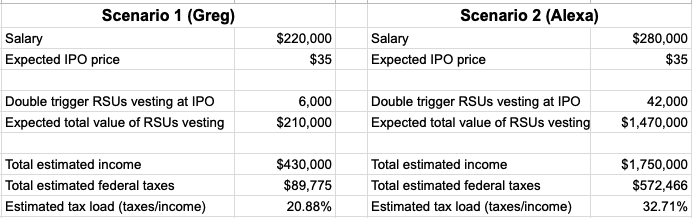
Let’s choose two situations.  The first scenario is for Greg and the second scenario is for Alexa.  We assume that both Greg and Alexa have families and are expecting an IPO to happen at year end.  This IPO will help them each with buying their next home and getting closer to financial independence.  The biggest difference between them is that Greg started at the company as an IC and Alexa came on as a Director.  What could their taxes look like?

Example of tax withholding on RSUs at IPO

By estimating what their total income for the year will be and the taxes due, we can get an idea of what their estimated tax load (aka ‘effective tax rate’ may be).

Other considerations for estimating taxes

Some bigger pieces we are leaving out of these examples are:

If your salary is low, chances are your withholding on your salary is much lower than needed at the IPO.  Salary withholding tables were made by the IRS assuming your salary is your main income.  It matches tax withholding requirements with that income expectation.  If both spouses are working, this effect is magnified.

If you have ISOs or NQSOs to consider, the math gets way more complex.  We recommend working with your tax advisor or financial planner to create the best strategy for you.

Other sources of income may change the math as well. If you do consulting on the side, have other IPOs in the same year (yes, this has happened to our clients in the past!), or long term rentals, then you will need to up your estimate.

Now let’s see how the 22% and 37% tax withholding election could work out for them.

Examples at 22% tax withholding

This is where total estimated income and the effective tax rate matter.  Let’s break down the withholding made a bit further between salary and the RSUs vesting at an IPO.

22% tax withholding on RSUs at IPO

In this case, the difference in total income makes a huge difference in how much more they will still owe come tax time.  Greg may view the risk of $10,000 needed in cash to cover the shortfall as ‘worth the risk’ or up his withholding in case the stock price drops.  Alexa’s shortfall could be catastrophic if she isn’t ready to pay $200,000 at tax time.

What are the downsides to taking on the risk of lower tax withholding?

This comes down to what you can afford to take risk wise and what you can’t.  Greg may have $10,000+ in cash savings annually and see this as a high risk/high reward worth electing the lower 22% tax withholding for.

Alexa may not have $200,000 laying on the sidelines to pay her taxes with.  Even more importantly, what if she did??

Each IPOing employee in this situation should ask themselves: 

1. If you sell more for withholding now and it goes up, how would you feel?

2. If you don’t sell enough to cover taxes now and it goes down, how would you feel?

In Alexa’s case, how would she feel paying $200,000 in to cover taxes only to see the stock tumble?  If the answer is 🙁, then Alexa should select 37% withholding.

Another consideration is the lockup period.  Most IPOing companies have a 180 day lockup period (with some caveats).  I don’t have data on how IPOs tend to look 6 months out, but there is a great study at NASDAQ on what happens to IPOs over the long run.  Long term, the majority of IPOs do not perform well and drop below their IPO price.  This is something to consider in your risk assessment.

Examples at 37% tax withholding

What would happen in each of these scenarios at 37% withholding?  Each would end up with a refund after filing their taxes.  

37% tax withholding on RSUs at IPO

I like to think of this as selling some shares at the IPO price – because that is effectively what will happen.  🙂

Through these two examples, you now have an idea of what a 22% tax withholding rate vs 37% tax withholding rate might mean for you.  The important thing is that you know what to expect – uncertainty and big tax bill surprises can take the fun out of your Company’s IPO.  

Interested in learning more?  Sign up for our newsletter

The above discussion is for informational purposes only.  Recommendations are of a general nature, not based on knowledge of any individual’s specific needs or circumstances, and there is no intent to provide individual investment advisory, supervisory or management services.

What are Double Trigger RSUs and how are they treated?

double trigger rsus

Double trigger RSUs are a popular type of stock compensation leading up to an IPO.  They are better for the employer – who doesn’t need to recognize stock expenses until IPO.  They are less mental energy for the employee – who doesn’t have to pay taxes or make sell decisions until IPO.  

What is the difference between single-trigger and double trigger RSUs?

RSUs are Restricted Stock Units your company gives you as an incentive to build company value.   
 
The ‘single trigger’ versus ‘double trigger’ translates to 1 requirement or 2 requirements to ‘trigger’ vesting.  
 
Single trigger vesting is generally based on ratable vesting over a period of time during employment (‘Service Vesting’).  Double trigger RSUs include another vesting component.
 
If you have single trigger RSUs, check out our RSUs Basics blog post.
 

How does double trigger vesting work?

Double trigger RSUs are service vested (first trigger) and release at an IPO/exit  (second trigger).   When one unit meets both of these triggers, it vests to you and you receive one share of company stock.
 
Double trigger RSUs are different from stock options because there is no ‘option to buy’ the stock.  Instead of having an option, your RSU immediately vests into stock when both triggers are met.  At that point, you make the decision when to sell it.
 

What happens to a double trigger RSU at an IPO?

Double trigger RSUs are generally taxable as ordinary income (like your salary) at IPO.  
 
The income and tax withheld (federal and state) at vest will be on your IRS Form W-2 from the company in the vesting year.
 
Since you pay income taxes on the vesting amount, this becomes your new ‘cost basis’.  Each Custodian accounts for this a little differently on tax forms.   Some adjust it on the 1099 and others provide a supplemental form that shows the true gain/loss on sales.
 
This is why maintaining your trade confirmations or statements from the custodian (i.e. Schwab, Shareworks, etc) is important.  
 
If you miss those details on the supplemental form, then you could be paying doubled up taxes.  If you know about how much vested, then you will know whether the 1099 looks right.  
 

Does my company pay my taxes on the double trigger RSUs at vest?

Some employees are surprised when 40%+ of their vested shares sell for tax withholding purposes.  Others end up with a surprise when they owe the IRS money on their tax return!  
 
This happens because tax withholding ≠ tax due.  Stock compensation is withheld at only 22% federally on the first $1M in stock/bonuses.  This may differ from your actual effective tax rate in the end.  If your effective tax rate is higher than 22%, be sure to set aside a higher percentage to help fund the tax bill.  
 
At a state level, this can vary.  Some states have a flat income tax, while other states (like California) have a different  withholding rate from the tax rate. This means you may owe more taxes at a state level as well.
 

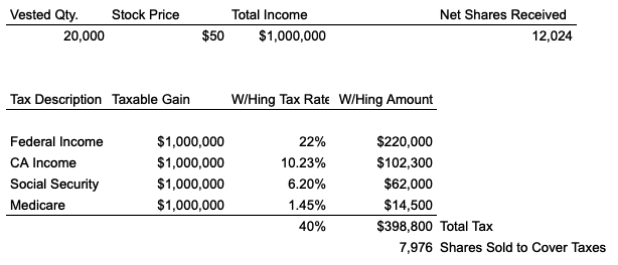
What is an example of taxes on a double trigger RSU?

Here’s an example of what it might look like.

Example of taxes on double trigger RSUs 
40% of the shares sold for tax purposes, but this may not be enough withheld for Federal taxes if the individual makes over $1,000,000 in total. They may need to be ready to pay 10% or more ($100,000+) in taxes towards these shares on their tax return too.
 

When double trigger RSUs vest, you will want to make sure you account for this as you decide what to do with the shares.

Do I owe taxes on my double trigger RSUs if I hold onto them after the IPO?

If you decide to hold onto your shares after vesting, your stock will be like other stock investments.   
 
If you decide to hold onto them, your holding period will start the day the shares vested to you and capital gains/losses will apply based on that date.
 
As a reminder: since you already paid ordinary income taxes on the value at vesting, your basis will be the fair market value from your vest date.  
 

Do I owe taxes on my double trigger RSUs if I sell them after IPO?

After vesting, the stock is treated like any other stock investment.  Capital gains/losses apply.
 
The type of capital gains tax is based on the length of time you hold the shares from the vesting date as well.  Long term capital gains rates apply when you hold the stock more than one year from the vesting date.
 
After vesting, the swings in the stock price will count towards capital gains /losses on your tax return.  This means you may owe more taxes on sale (if the stock appreciates beyond the vest value).  If the stock loses value, you will not be able to offset the vesting income with the losses.  Those losses are considered capital losses that can only offset other capital gains.
 
Example:  Using the above example, your basis in the shares would be $1,000,000.  If you sold the shares for $1,500,000 at a later date, you would be subject to capital gains tax on $500,000.   
 
Depending on the time held, you would pay short term or long term capital gains tax (and the net investment income tax above a certain income level).
 
If you hold the stock and the price drops below the value at vesting, you may recognize a capital loss.  You may be able to use those losses to offset capital gains from your company stock.  Losses greater than current capital gains offset income up to $3,000 a year.  Any unused losses carry forward to future years.  Unfortunately, you can not claim the taxes paid at vesting back.  This is one risk of many encountered in holding your company stock long term.
 
Following with the above example, if your basis in the shares is $1,000,000 and you sold the shares for $750,000 at a later date, you would have a loss of $250,000.  Depending on other investment sales and capital gain distributions, you may be able to offset some of this loss or not.  If you do not have any, you would only be able to claim $3,000 of capital gains loss on your tax return.  The remaining $247,000 loss would carry forward to future tax returns.
 
This is where having an investment manager who can help you with gain harvesting may come into play.  Check out our blog post on Do I need an investment manager? as well.
 

What happens to a double trigger RSU if you leave?

This will depend on the specific plan document for your company.  
 
Generally, most double trigger RSUs are like regular RSUs at termination:
 
  • If you have double trigger RSUs that are not time vested, those will expire immediately.
  • If you have double trigger RSUs that did meet the time vesting component, it may depend more on whether termination was ‘for Cause’.
  • In this case, ‘for Cause’ termination may result in complete termination.  ‘Not for Cause’ termination is gentler and usually allows you to be eligible for the time vested RSUs to vest at IPO or exit.
This can be a bit more complicated tax-wise as well if you leave the state you were working in as the RSUs ‘Service vested’ too.  
 
SeedSafe has worked with IPOing tech professionals since 2016 and we’ve gone through this many times.  You may only experience it once, but the outcomes can be life changing.  Our goal is to empower you with clarity and understanding of the process and outcomes.
 
We recommend all IPOing employees to bring on a financial advisor during the process to make sure nothing falls through the cracks.  If you are looking for a financial advisor and tax advisor to help you through the process, please reach out to us.
 
Interested in learning more? Sign up for our newsletter
 
The above discussion is for informational purposes only.  Recommendations are of a general nature, not based on knowledge of any individual’s specific needs or circumstances, and there is no intent to provide individual investment advisory, supervisory or management services.
 

What should I do if my startup announces a tender offer?

startup tender offer

What does it mean for my startup to have a tender offer?

A tender offer is a startup’s way of providing liquidity to employees and offering shares to others.  Often we see this start to happen as the company gets closer to IPO or decides to delay IPO.  In part, this helps employees see the value of their hard work and in part helps the company provide stock to potential investors.

Generally, we see startup tender offers limited to a maximum of $X or Y% per person.  The more common caps we’ve seen are up to $1 million in value or 50% of stock outstanding.  This is because tender offers are generally fueled by investor money or profits and so there is a total cap.  If the tender offer is ‘oversubscribed’, that means there is more demand for tendering shares for cash than can be fulfilled.  In this case, your total request of shares to be bought back may be further limited.

Review your personal financial situation to decide whether participating in the tender offer is right for you.  

  • Are you hoping to buy a new home?
  • Are you expanding your family and want to get a head start on college funding?
  • Will you be leaving the startup soon and need to plan for a potential clawback?
  • Do you want to exercise more stock options and are facing a cash crunch?
  • Do you want to diversify out of your startup stock a bit for future flexibility?

There are many opportunities in selling back some shares in a startup tender offer.  Other questions can be found in our tender offer basics post.

What should I consider during a tender offer?

  • Why is the company doing a tender offer?  Is this an opportunity for investors to get in when they believe the stock is undervalued?  Or is this to provide liquidity while waiting for IPO/M&A?
  • What is the valuation the shares are being offered at?  If the shares are ‘underwater’ i.e. under the exercise price for options or RSU vesting price, you may feel differently about tendering the options.  Generally, there is no reason to tender stock options under the exercise price.
  • How do I feel my company is doing?  Are you surprised at the valuation?  Do you see a long road ahead for the company?  Or do you feel the company is at a lower point now with the right metrics to get it to an even better Series XYZ in a year or two?  Although your assessment is biased, it is something to consider and weigh the risk / reward of keeping more shares.  I like to ask the question as: If you had the value of what you expect from the tender offer in cash, would you buy company stock with it?  
  • What are the tax implications?  Each type of stock option and currently held share may have different tax implications in a tender offer. 
  • Which experts are in my corner to make sure I am considering the implications?  Consult with your financial advisor or tax advisor to plan for the best outcome.  If you are looking for guidance, schedule some time with us to think through options HERE.

What are the tax implications in tendering my shares?

  • Unexercised stock options:  the difference between the sales price and exercise price will be treated as ordinary income (compensation)
  • Exercised ISOs:
    • If held short term or less than 2 years from grant date, this would disqualify the special tax treatment and turn it into an NQSO sale.  We rarely recommend doing this since you may have already paid AMT taxes at exercise and will not be able to get a credit back.  This will be treated as ordinary income (compensation)
    • If held long term, this will result in long term capital gains/losses
  • Exercised NQSOs:  short term or long term capital gains/losses
  • Vested RSUs:  short term or long term capital gains/losses
  • Unvested RSUs:  these are generally ineligible for tendering

Beyond what type of income or gains/losses each type of stock will be, there is also the question of who is paying any taxes due to the IRS and state tax department.  We suggest reviewing your paystub post-tender offer to see what came through the paystub vs. what did not.  You will be liable for the taxes in the end, so it is better to know now than when you file your tax return.

Is a tender offer better than an IPO?

Startup tender offers can be rewarding and less stressful.  Instead of watching the market daily while you wait out your lock up period, a tender offer allows you to review your finances with a known price.  It is a great way to financially profit while waiting for an IPO or Merger to happen “one day”.

I love it when a long-time startup employee comes to us with RSUs and ISOs in a tender offer.  Then, we work together to find the best strategy based on their situation.  Our goal is to understand where you want to be financially and keep it front in center.  Then, we balance tax implications, risk exposure, and long term growth at a level you are comfortable with.

For many of our clients going through tender offers with RSUs and ISOs we are able to purchase ISOs, minimize AMT taxes and diversifying out a large portion of cash from the event.  This makes my heart sing for my clients!

Can a startup force a repurchase of shares?

This is often called a ‘Clawback provision’.  If a startup includes a clawback in the plan documents, the company may be able to repurchase shares at termination or in the case of an exit.    Typically, the buy back will be at the fair market value of the shares at that time and can prevent you from realizing the full value of owning the shares.  

An example of the downside of clawbacks can be seen in the Skype acquisition by Microsoft.  Read more about it HERE and see some in depth examples HERE.

Another example of a clawback in action is if you make an 83(b) election and leave before your shares fully vest time-wise.  The company typically has 90 days to repurchase any of your unvested shares at the same price you paid. 

Those are the most common examples of a forced buy back, but not something we commonly see occur as part of a tender offer.

In the end, the best plan for a startup tender offer is the one where you decide how this event can get you closer to your financial goals.

If you are looking for a thinking partner in how to optimize and streamline your finances, schedule some time to chat with us.

Interested in learning more?  Sign up for our newsletter

The above discussion is for informational purposes only.  Recommendations are of a general nature, not based on knowledge of any individual’s specific needs or circumstances, and there is no intent to provide individual investment advisory, supervisory or management services.


Should I opt into the Google Employee Trading Plan?

Google Employee Trading Plan

The Google Employee Trading Plan is a 10b5-1 plan that allows you to set up a trading program outside of the annual trading windows.  It also helps alleviate the pressure to sell at the right time or to need to make a decision every time the stock vests.

The trading plan starts with a cooling off period where you cannot sell stock for a few months and then goes into action in August.  The plan will continue until July the following year.

There are many options within the Google Employee Trading Plan for selling prior vested GSUs and future vestings (starting with August).  If you do decide to sell prior vested GSUs, there will be an option of which shares to sell and how to sell them.  Two of those options are FIFO and LIFO.  FIFO means selling the shares you first received long ago and still hold.  This will sell long term held GSUs.   LIFO will sell shares most recently vested.  Prioritizing recently vested shares may result in short term capital gains that are taxed at higher tax rates.

What should I consider?

When you are thinking about whether to opt into the plan, a few factors to consider are:

  • Company performance
  • Stock volatility
  • Need for diversification
  • Trading plan restrictions
  • Your financial plan

Below are a few of the thoughts we take into consideration of our clients when reviewing whether the plan is helpful for them.

Why opt into the Google Employee Trading Plan?

Company performance:  If you don’t believe in forecasting or don’t know what to expect, then you may want to capture it systemically.  You may also review trends and see that the stock tends to drop after trading windows open for employees.

Stock volatility:  If the changes in stock value makes it hard to sell, you may want to opt in to the trading program to reduce decision fatigue.

Need for diversification:  If the majority of your net worth is from vesting GSUs, then you may wish to diversify your portfolio or add liquidity.  Trading windows would restrict when you could use the money.

Trading plan restrictions:  If you live in a more expensive place, you may need to use some shares for mortgage payments and living expenses.  A trading program using VWAP will allow you to receive the cash from each RSU vesting on a monthly basis to align with your spending and savings.

Your financial plan:  Opting in will allow you to build a snowball of selling shares and putting the cash towards your investments and life goals.  This may mean saving more towards a home, expanding your family, supporting parents, or leaning into investing in owning your time in the future.

Why not opt into the Google Employee Trading Plan?

Company performance:  If you think Google is riding the wave of AI, user growth, and is going to kill it this year, then you may believe in timing a sale.  You may decide to review financial performance and news after each trading window opens up to determine what you want to do.

Stock volatility:  If you prefer to attempt to ‘game’ the volatility and sell on a local high within the trading windows, then you may want more control than a trading plan offers.

Need for diversification:  If you prefer to take the risk of maintaining your career and investment portfolio all with one entity.

Trading plan restrictions:  If you don’t need the shares for living expenses or an upcoming purchase.  Or, you may want the opportunity to change your mind on selling previously vested GSUs through the year.

Your financial plan:  If your financial philosophy is about placing big bets in the hope for big returns and grinding until that point, then you may not see a need to opt in.  Caution: this is more of a speculative decision than a financial plan.

Our recommendation

When you want to streamline your finances and add clarity to your life, a trading plan frees you emotionally and timing wise.  You are able to flex your financial freedom muscles knowing each month you are getting closer to your financial goals and a stable future.  

The employee trading program can be freeing for most financial plans.  You are able to take the compensation you’ve earned and use it towards investing in yourself, your family, and your long term success.

That is our philosophy.  What is yours?  What is money’s purpose in your life?

If you are looking for a thought partner in your financial life, schedule a chat with us.

Interested in learning more? Sign up for our newsletter

The above discussion is for informational purposes only.  Recommendations are of a general nature, not based on knowledge of any individual’s specific needs or circumstances, and there is no intent to provide individual investment advisory, supervisory or management services.